Category: Finance

  • Meezan Bank & Institute of Business Administration (IBA) join hands to launch Meezan Justuju – An Islamic Finance Talent Development Program for Fresh Graduates

    Meezan Bank, Pakistan’s leading Islamic bank has recently launched Meezan Justuju – a fully funded talent development program for fresh graduates in collaboration with IBA-CEIF (Institute of Business Administration – Centre for Excellence in Islamic Finance). The Program’s initial screening, conducted through a written test at Meezan House, received an overwhelming response, attracting participants from various disciplines.
    Meezan Justuju is a two-month certificate course designed to equip fresh graduates with comprehensive knowledge and expertise in Islamic banking and finance, dedicated to meeting the growing demand for skilled professionals in the industry.

    The Program’s curriculum has been strategically developed to prepare a pool of talent well-versed in Islamic finance, enabling them to pursue diverse career paths within Islamic banks, Takaful companies, Mudarabah companies, Islamic asset management companies, and Islamic banking divisions or windows.

    Mr. Ahmed Ali Siddiqui – Group Head Shariah Compliance at Meezan Bank, while speaking about the program, stated, “Meezan Justuju is a testament to our commitment to nurturing Islamic finance talent. By providing the youth with the right skills and knowledge, we aim to bridge the existing skill gap in the industry. This Program serves as a stepping stone for fresh graduates to initiate promising careers and contribute to a more responsible and equitable financial system.”

    Also Read: Roshan Digital Accounts (RDAs) Witnessed Stellar Foreign Exchange Inflows of $7.195 Billion by December 2023

  • Govt urged to resume affordable house financing scheme

    The government should resume the affordable house financing scheme through commercial banks to facilitate masses for purchasing and constructing residential housing units to revive economic activities across the country.

    This was stated by the real estate tycoon and founder of Shangrila City, Syed Afzal Hameed, at the annual meetup of developers and the launch of one-window solutions for allotees of the international housing project at a local hotel here on Thursday.

    Speaking to the media, he said the real estate stirs commercial activities in construction and various allied sectors, including steel, cement, paint, cable, marbles, etc, which ultimately benefits the economy through taxes and employment opportunities.

    Real estate is the mother of the construction industry, it contributes a significant role to the GDP every year, he remarked.

    Despite various challenges, the administration of Shangrila City introduced housing projects for middle-income groups, including an international-themed apartment, and began the process of procession to allotees at a given time.

    He added that owning a decent residential unit is a dream these days, but it had been made possible through affordable projects launched by Aimal Builders.

    On the occasion, the CEO of Al Meeraj Marketing, Kashan Siddiqui said the success of any housing project depends on its construction, facilities, amenities, and payment structure, which the administration of Shangrila City assured to win the trust of its customers.

    He lauded the role of partners and dealers in this project to make it successful, which began to receive booking of the housing units from day one of the launch, receiving overwhelming response from the buyers and investors.

    The annual event was also attended by the city’s renowned builders, developers, and dealers.

    Also Read: Roshan Digital Accounts (RDAs) Witnessed Stellar Foreign Exchange Inflows of $7.195 Billion by December 2023

  • Roshan Digital Accounts (RDAs) Witnessed Stellar Foreign Exchange Inflows of $7.195 Billion by December 2023

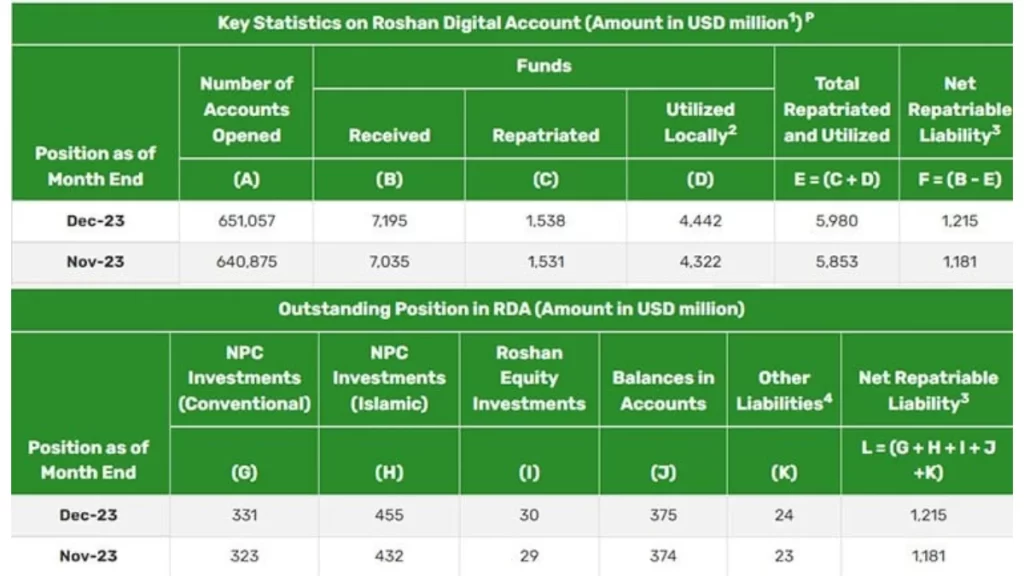
    The State Bank of Pakistan (SBP) has reported a robust performance of the Roshan Digital Accounts (RDAs), indicating a significant foreign exchange inflow of $7.195 billion by the end of December 2023.

    According to the SBP data, a comprehensive overview of the RDAs revealed that $1.538 billion had been repatriated, while $4.442 billion was utilized locally, resulting in a net repatriable liability of $1.215 billion as of December 31, 2023.

    In December alone, funds received through RDAs amounted to $160 million, with $7 million repatriated. The local utilization of funds during the same period stood at $120 million. The net repatriable liability for December was recorded at $34 million.

    The data further unveiled that since the launch of RDAs, a total of 651,057 accounts have been opened, signifying a notable 1.6 percent month-on-month increase.

    Roshan Digital Accounts

    Breaking down the figures for December 2023, the total net investments through RDAs amounted to $816 million. NPC Investments (Conventional) accounted for $331 million, while NPC Investments (Islamic) recorded an impressive $455 million. Roshan Equity Investments contributed $30 million to the overall investment portfolio. The Balances in Accounts were reported at $375 million, accompanied by Other Liabilities totaling $24 million.

    The consistent growth and positive trends observed in RDAs highlight their pivotal role in attracting foreign exchange inflows, contributing significantly to the economic landscape of Pakistan. Investors continue to show confidence in the Roshan Digital Accounts, establishing them as a preferred avenue for international transactions and investments.

    Also Read: Arslan Ash Secures Victory at Tekken World Tour Championship

  • Raqami Islamic Digital Bank Collaborates with Euronet Pakistan for Pioneering Digital Payments

    In a groundbreaking move, Raqami Islamic Digital Bank (RIDB) and Euronet Pakistan Pvt. Ltd. have entered into an exclusive agreement aimed at promoting digital payments in Pakistan.

    The journey began in January 2023 when RIDB secured a no objection certificate (“NOC”) from the State Bank of Pakistan (SBP) to establish the country’s first Islamic digital retail bank. Following this, in September 2023, the SBP granted In-Principal Approval (IPA) to RIDB and four other contenders for the digital bank license. The IPA set the stage for RIDB to focus on operational readiness, with plans for a pilot phase followed by the commercial launch as a digital retail bank.

    Euronet Pakistan, a division of the NASDAQ-listed Euronet Worldwide (EEFT), renowned for secure electronic financial transactions, is set to play a pivotal role in this transformative partnership. The company brings a wealth of experience as the world’s largest global provider dedicated to banking and payment technologies.

    Under the agreement, Euronet Pakistan will provide RIDB with a suite of services, including a Payment Switch, Card Management Solution, Credit Cards, ATM Controller, POS/E-Commerce Acquiring, Fraud Management Solution, and Card Tokenization.

    Selecting a payment system is a strategic process for a bank, involving the careful selection and implementation of a technology platform that facilitates a wide range of financial transactions. RIDB aims to enhance operational efficiency, reduce costs, improve service availability, and ensure a seamless digital banking experience for its customers through Euronet’s advanced system.

    Kashif Gaya, CEO of Euronet Pakistan, expressed excitement about being selected as Raqami’s technology partner. Gaya highlighted the company’s commitment to supporting RIDB through its next-generation digital platform, emphasizing scalability and agility for rapid product and service delivery.

    Umair Aijaz, CEO of RIDB, emphasized the importance of a well-designed payment hub in the era of digitization. He stated, “As Raqami prepares to launch as Pakistan’s first Islamic digital retail bank, we are committed to playing our part in this evolution. This exclusive agreement between Raqami and Euronet is a key partnership that will help set the foundation for the country’s first Islamic digital bank.”

    Nadeem Hussain, Coach RIDB, noted the positive impact of the SBP’s efforts to enhance the digital ecosystem in Pakistan, with digital transactions accounting for approximately 80% of total retail transactions. He expressed confidence that the partnership with Euronet would not only benefit both entities but also cater to the needs of an increasingly digital-savvy clientele.

    RIDB, one of the five aspirants for the digital retail bank license, is poised to contribute significantly to the digitization drive led by the Government of Pakistan and the SBP. The collaboration with Euronet marks a strategic step toward achieving scale and meeting the evolving expectations of Pakistani customers in the digital era.

    Also read: SECP Mandates Inclusion of UDIN in All Audit Reports
  • ADFIAP announces Saud Minam as Chairman

    The Association of Development Financing Institutions in Asia and the Pacific (ADFIAP) has announced a significant transition in leadership, with the elevation of Saud Minam, a prominent Pakistani in Fiji, as its new Chairman.

    Saud Minam, CEO of Fiji Development Bank, brings with him around 30 years of experience in the financial sector. He is an active member of the Pakistani community in Fiji and, in 2021, assisted the Fijian government by raising $5,000 in donations along with more than 500 kilograms of clothes to assist relief efforts after Tropical Cyclone Yasa.

    In Pakistan, members of ADFIAP have been playing a critical role for the advancement of sustainable development. Zarai Taraqiati Bank Limited (ZTBL) has launched a pilot project of farmers training to inculcate best practices in crop production, orchard farming and livestock & dairy development for the farmers. The House Building Finance Company Ltd of Pakistan has also launched the Ghar Ujala Scheme to provide cost-effective financing option for installation of solar energy systems.

    Founded in 1976, ADFIAP has currently 90 member-institutions in 40 countries and acts as the focal point of all development banks, and other financial institutions, engaged in the financing of development in the Asia-Pacific region.

    Also Read: Google Fires Thousands of Employees in Its Assistant Team

  • Car Sales Experience Sharp 66% Decline in December

    In a significant downturn for the automotive industry, car sales in December witnessed a staggering 66% plunge, marking a concerning trend that industry analysts attribute to inflation and the challenges posed by unaffordable auto financing.

    The data paints a grim picture for the automotive sector, revealing a substantial contraction in consumer demand for cars. The steep decline raises concerns about the overall economic impact, reflecting the financial strain on potential car buyers. The double whammy of inflation and unattainable auto financing options has created a challenging environment for individuals looking to make a vehicle purchase.

    The adverse effects of inflation on consumer purchasing power cannot be overstated. As prices across various sectors continue to rise, consumers find themselves grappling with increased living costs, leaving them with limited discretionary income. In such a scenario, major purchases like cars become a luxury that many are forced to forego.

    Unaffordable auto financing exacerbates the situation, further restricting access to the automotive market. As potential buyers face stringent lending terms, high-interest rates, and challenging credit requirements, the dream of owning a car becomes unattainable for a significant portion of the population.

    The auto industry, which plays a pivotal role in economic growth and employment, is feeling the brunt of these adverse conditions. The sharp decline in car sales not only impacts manufacturers but also has a ripple effect on the entire automotive ecosystem, affecting dealerships, suppliers, and associated businesses.

    Industry stakeholders are closely monitoring the situation, emphasizing the need for policy interventions and measures to address the challenges faced by both consumers and the automotive sector. As the country navigates economic uncertainties, finding solutions to make car ownership more accessible and affordable becomes imperative for sustaining the vitality of the automotive industry.

    The coming months will be crucial for assessing whether the automotive sector can rebound from this significant setback. Government initiatives, industry collaborations, and innovative financing solutions may hold the key to revitalizing car sales and restoring consumer confidence in the market.

    Also Read:Elections, journalism, and transparency: CEJ-IBA launches fact-checking initiative ahead of General Elections 2024

  • Pakistan Customs Implements TIR Rule Amendments

    In a proactive measure to elevate the efficiency of cross-border trade, Pakistan Customs has recently introduced significant amendments to the TIR (Transports Internationaux Routiers) rules. This strategic initiative is geared towards not only streamlining trade processes but also making them more cost-effective, providing a substantial boost to businesses engaged in international transport.

    The revised TIR rules by Pakistan Customs signify a dedication to creating an environment that is conducive to seamless trade operations. The amendments are poised to usher in a new era for enterprises involved in cross-border transportation, offering a multitude of benefits that extend beyond mere efficiency improvements.

    By optimizing trade processes, these amendments aim to reduce operational costs for businesses engaged in cross-border trade, making it a more economically viable and attractive option. The streamlined procedures are expected to result in faster customs clearances, reduced transit times, and an overall improvement in the logistics and supply chain landscape.

    Furthermore, these changes underscore Pakistan’s commitment to aligning with international standards and fostering global trade partnerships. The TIR rule amendments position Pakistan as a proactive player in the international trade arena, signaling to the business community that the country is dedicated to providing a conducive environment for cross-border commerce.

    For businesses navigating the complexities of international transport and trade, the revised TIR rules by Pakistan Customs present an opportunity for increased operational efficiency, cost savings, and a more favorable business environment. As these amendments come into effect, enterprises can look forward to reaping the benefits of a streamlined and cost-effective cross-border trade landscape.

    Also Read: Google Unveils Cutting-Edge Features for Electric Vehicles, Enhanced Integration at CES 2024

  • Ali Ahmed Khan Appointed as President Middle East, Pakistan, and Africa (MEPA), Joins Executive Board of FrieslandCampina Global

    FrieslandCampina Engro Pakistan announces the promotion of Ali Ahmed Khan to the position of President of the Middle East, Pakistan, and Africa (MEPA) region at FrieslandCampina.

    Ali’s exceptional leadership and visionary approach have been pivotal in his transformative tenure as Managing Director of FrieslandCampina Engro Pakistan (FCEPL). Under his guidance, FCEPL has experienced significant growth and profitability and continues to increase its market share across all categories.

    Ali Ahmed Khan’s exemplary performance has also led to his appointment to the executive board of FrieslandCampina Global.

    The Company is confident that Ali’s strategic vision and leadership will continue to drive growth and success in the MEPA region for FrieslandCampina.

    He will be succeeded by Syed Kashan Hasan as Managing Director of FCEPL, effective February 1st, 2024. Bringing 22 years of rich experience across commercial functions, Kashan Hasan is a seasoned professional with a history of driving performance and innovation. His career spans various regional and global roles across Pakistan, South Africa, the UK, the Middle East, and North Africa. Before joining FCEPL, Kashan served as General Manager at Reckitt for the Pakistan business and most recently he served as the CEO of Shan Foods. A graduate of IBA, Kashan is known for his ability to develop insights, devise innovative solutions, and challenge norms.

    Also read: Thar Foundation Transforming Lives of Millions in Thar

  • ABHI and foodpanda Collaboration: A Game-Changer for Home Chefs in Pakistan

    ABHI and foodpanda Collaboration:

    In the throes of the COVID-19 pandemic, while many businesses struggled to stay afloat, a heartening story of resilience and entrepreneurial spirit emerged from Lahore, Pakistan. Shamshad Ahmed, the owner of a school canteen named POLA G LunchTime, faced daunting challenges when schools shut down. His journey from near closure to thriving success stands as a testament to the power of innovation and collaboration in times of crisis.

    The Onset of Crisis:
    When the Pakistani government ordered schools to close to curb the spread of COVID-19, Ahmed’s primary source of income came to an abrupt halt. His business, once bustling with the energy of schoolchildren, was suddenly quiet and deserted. Ahmed faced the stark reality of the pandemic’s economic fallout, a narrative familiar to many small business owners globally.

    Turning Point: foodpanda’s Intervention:
    As the pandemic redefined normalcy, foodpanda, a prominent player in Pakistan’s food delivery industry, stepped in to bridge the gap for home chefs and small business owners. Ahmed joined foodpanda’s platform, transforming his business model to cater to a wider audience beyond the school’s gates. This strategic pivot allowed POLA G LunchTime to reach a broader customer base, offering comfort food in a time of widespread discomfort.

    Financial Empowerment by ABHI:
    The story took a further positive turn with the intervention of ABHI, Pakistan’s first financial wellness platform. In partnership with foodpanda, ABHI offered financial assistance to small business owners, including quick access to working capital. This support was crucial for Ahmed, enabling him to scale up his operations and keep his business afloat during the pandemic’s uncertain economic landscape.

    Impact and Growth:
    The collaborative effort between foodpanda and ABHI not only helped Ahmed’s business survive but also thrive. The partnership is a striking example of how innovative financial solutions can empower entrepreneurs, leading to job creation and contributing to the broader economic revival in Pakistan during challenging times. Ahmed’s story, from the brink of closure to a flourishing enterprise, mirrors the resilience and adaptability of small businesses worldwide.

    Ahmed’s journey with POLA G LunchTime is more than a tale of individual success; it’s a narrative about the strength of collaborative efforts and the resilience of the human spirit in the face of adversity. As the world grapples with the pandemic’s ongoing challenges, stories like Ahmed’s offer hope and inspiration, demonstrating that innovation and partnership can lead the way to recovery and growth.

    Also Read: Easypaisa Finally Lets You Unlink Your Account From Unwanted Services

  • Thar Foundation Transforming Lives of Millions in Thar

    The docu-series ‘Portraits of Thar’ delves into the uplifting narratives of the heroes of Tharparkar

    Thar Foundation, in collaboration with Thar Block II entities, unveiled the ‘Portraits of Thar 2.0’ campaign at a compelling screening hosted at the Karachi Press Club amongst media delegates. This heartfelt project by Thar Foundation aims to vividly showcase the inspiring narratives of the Thari people, highlighting their unwavering resilience and championing change within the region.

    Thar Foundation, the CSR wing of Thar Block II entities, maintains a dedicated commitment to the UN Sustainable Development Goals (SDGs) framework. Its focus spans across interventions on priority areas of SDGs, including the alleviation of poverty, establishment of sustainable livelihoods, improvement of healthcare and education accessibility, and the promotion of gender equality.

    Under SDG 4 for quality education, Thar Foundation has established a network of 23 school units within Thar. Over 5,000 students are currently enrolled in these school units, out of which approximately 56% are female teachers, empowering the educational journey within areas of Mithi, Islamkot and adjoining villages.

    “In the vibrant heart of Thar, an unspoken revolution is unfolding. The Thar Foundation is enabling to uplift the landscape and foster widespread community enhancement. It’s the unwavering spirit of our community that is truly transforming Thar, where the youth have access to equitable socio-economic opportunities through education, vocational training, and employment —these individuals are the unsung heroes shaping the present and future of the community and the country,” said Amir Iqbal, CEO of SECMC and TF.

    The ‘Portraits of Thar 2.0’ campaign illuminates the extraordinary stories of four exceptional leaders – Hothi Ram, Guddi, Nehal Chand, and Jahawar Lal. These individuals stand as beacons of leadership amidst millions in Thar, each crafting their indigenous tales of resilience and perseverance. Their journeys are not just personal triumphs; they symbolize the indomitable human spirit.

    Hothi Ram’s evolution from a laborer to Warehouse Supervisor in Village New Senhri Dars signifies unwavering determination. Nehal Chand’s tireless efforts as a community mobilizer have sparked positive change, empowering his village. Guddi’s unwavering resilience following a severe spinal injury epitomizes unparalleled strength, and Jahawar Lal’s dedication as a teacher-turned-principal in village Kharo Jani is a testament to transformative education. These heroes, alongside countless others, exemplify the essence of leadership and serve as inspiring role models, illuminating the path for progress in Thar.

    Also Read:Ghandhara Tyre celebrated its 60th anniversary in Pakistan