Category: Finance

  • Mobilink Bank and Fatima Fertilizer partner to provide access to finance to empower the agri-community

    Pakistan’s largest digital microfinance institution, Mobilink Bank and Fatima Fertilizer, a leading player in Pakistan’s agricultural sector, have entered into a strategic partnership to digitally empower Pakistan’s underserved farming communities through enhanced access to finance and financial technology. The collaboration aims to uplift the country’s agri-community by digitizing the agricultural supply chain and providing targeted financial solutions through the integration of Mobilink Bank’s ‘Dost App’ and Fatima Fertilizer’s ‘Sarsabz Pakistan’ platform.

    This partnership brings together two leaders in their respective sectors, with a shared commitment to transforming rural livelihoods. The alliance will unlock new opportunities for the farming community, and agri-based small and medium enterprises (SMEs) by combining Mobilink Bank’s inclusive financial products with Fatima Fertilizer’s strong grassroots presence in order to drive social mobility.

    As part of this collaboration, farmers will be able to access a wide range of Mobilink Bank’s financial products and services, including agri tubewell financing, input lending, passbook financing, as well as digital banking through the seamless integration of the Dost App with the Sarsabz Pakistan platform.

    In addition, the partnership will also focus on equipping farmers with essential financial literacy skills to help them make informed financial decisions. These offerings will be delivered not only through digital channels but also via on-ground engagements, including joint farmer community gatherings with Mobilink bank and Fatima Fertilizer designed to raise awareness, generate leads, and encourage the adoption of financial tools.

    “Agriculture is the backbone of Pakistan’s economy, and its progress is vital to our national prosperity,” said Haaris Mahmood Chaudhary, President and CEO of Mobilink Bank. “This strategic integration of our Dost App with the Sarsabz Pakistan App by Fatima Fertilizer is a leap toward building a future-ready, digitally inclusive agri-ecosystem. By simplifying access to finance for agri-inputs, we’re not just digitizing lending; we’re empowering farmers, strengthening rural economies, and paving the way for sustainable growth.”

    Also sharing his thoughts, Asad Murad, Chief Operating Officer, Fatima Fertilizer Company Limited, added, “At Fatima Fertilizer, we are deeply committed to enhancing the lives of farmers through innovation, accessibility, and collaboration. Our partnership with Mobilink Bank reflects a shared vision to drive financial inclusion and strengthen the agricultural ecosystem. By integrating digital finance with our Sarsabz Pakistan platform, we are not only bridging critical gaps in agri-input financing but also enabling long-term socio-economic growth in rural communities.”

    Mobilink Bank and Fatima Fertilizer’s joint efforts will extend beyond service delivery, contributing to broader financial inclusion goals through farmer education, digital access, and rural entrepreneurship development. The collaboration will not only empower the farmer community in the agri sector but also contribute to the Pakistan’s agri economy.

    Also Read: Meezan Bank Pays Tribute to the Armed Forces with a Heartfelt Ceremony
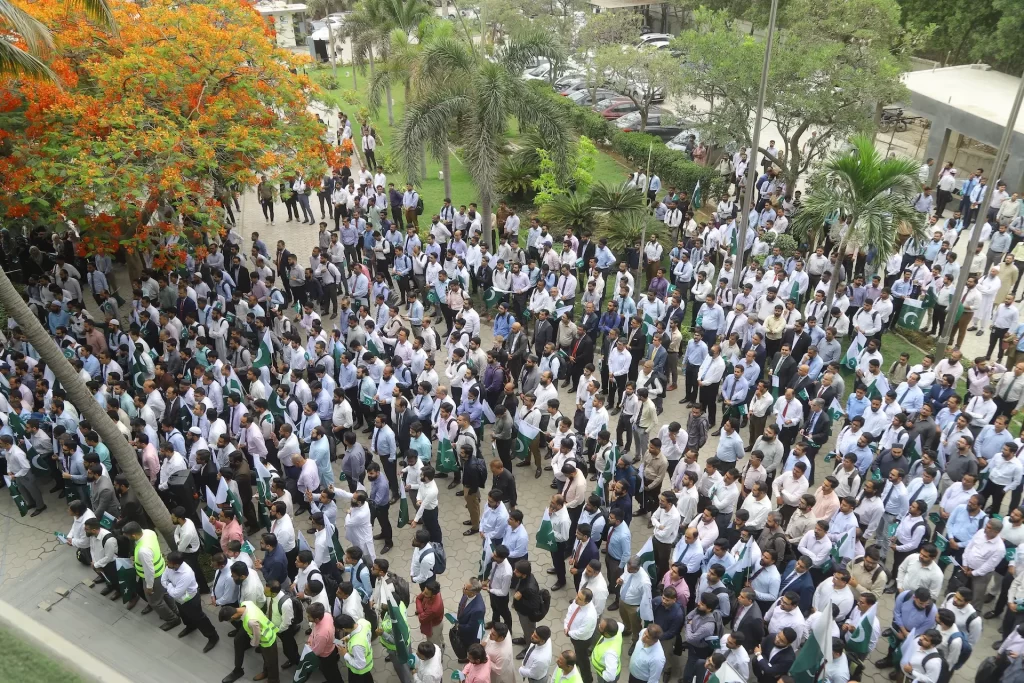
  • Meezan Bank Pays Tribute to the Armed Forces with a Heartfelt Ceremony

    In a heartfelt show of unity and gratitude, Meezan Bank held a special ceremony at its Head Office in Karachi to pay tribute to the courage and dedication of Pakistan’s Armed Forces.

    More than 3,000 employees, including the Bank’s senior leadership, came together to celebrate the spirit of sacrifice that defines our Armed Forces. The event featured passionate addresses by Mr. Irfan Siddiqui, President & CEO, and Deputy CEO Syed Amir Ali — both of whom spoke about Pakistan’s identity as a peace-loving nation and the Armed Forces’ unwavering role in safeguarding that vision.

    A soulful recitation of the national anthem and a moving Dua-e-Shukar added to the emotional weight of the gathering, bringing a deep sense of pride and reflection across the audience.

    This memorable event served as a powerful reminder of the values we hold dear — courage, unity, discipline, and love for our homeland.

    Meezan Bank proudly salutes our heroes and prays for continued peace, progress, and prosperity for Pakistan.

    Also Read: In a First for Pakistan, Senior Malaysian Banking Delegation Explores Meezan Bank’s Model for Islamic Banking Insights

  • Emirates Group achieves record profit of AED 22.7 bn (US$ 6.2 bn) in 2024-25

    Emirates is the world’s most profitable airline, and Emirates Group the world’s most profitable aviation group in the 2024-25 reporting period
    The Emirates Group today released its 2024-25 Annual Report, achieving new record profit, EBITDA, revenue, and cash balance levels. This outstanding performance places the Emirates Group as the most profitable aviation group globally in the 2024-25 reporting period, with Emirates reporting the best result in its history to become the world’s most profitable airline.
    Emirates earns its place as the world’s most profitable airline, reporting:
    • record profit before tax of AED 21.2 billion (US$ 5.8 billion), up 20% from last year
    • record revenue of AED 127.9 billion (US$ 34.9 billion), an increase of 6% over last year
    • highest-ever level of cash assets at AED 49.7 billion (US$ 13.5 billion), 16% higher compared to 31 March 2024
    This is the first financial year that the UAE corporate tax, enacted in 2023, is applied to the Emirates Group. After accounting for the 9% tax charge, the Group’s profit after tax is AED 20.5 billion (US$ 5.6 billion).
    HH Sheikh Ahmed bin Saeed Al Maktoum, Chairman and Chief Executive, Emirates airline and Group said:

    “It is no accident that Dubai has produced hugely successful global aviation entities including Emirates and dnata. Dubai’s aviation sector has become an influential force on the global stage thanks to visionary leaders, strategic planning, co-ordinated execution, and strong support from our customers, business partners, and all the people of Dubai.
    “When the government set up Emirates 40 years ago and we began expanding dnata’s capabilities to support the city’s growth, we had a clear mission – be the best at what we do; and deliver value to Dubai, our stakeholders, and the communities we serve.
    “With that in mind, we’ve kept a laser focus on providing great products and services, and we continually invest in technology and talent to increase our competitive edge. We look after our people and our customers, and we work hard to positively impact our communities. We don’t cut corners, and we don’t take shortcuts that put our future at risk for short term gains. By building our business models around these principles and Dubai’s unique strengths, the Emirates Group has thrived and stayed resilient through geo-political and socio-economic challenges over the years.”
    HH Sheikh Ahmed added:
    “For 2024-25, the Emirates Group has raised the bar to set new records for profit, revenue, and cash assets.” Emirates will strengthen its network connectivity with the expected delivery of 16 A350s and 4 Boeing 777 freighters in 2025-26.
  • InfraZamin Pakistan and SECP Stress Need for Advancing Green Financing through Capital Markets

    InfraZamin Pakistan in collaboration with the Securities and Exchange Commission of Pakistan (SECP), British High Commission Islamabad, and the Private Infrastructure Development Group (PIDG) hosted a seminar titled “Green Financing via Debt Capital Markets” in Islamabad. The event brought together senior professionals and international experts from the regulatory, financial, and development sectors to discuss the pivotal role of credit enhancement in mobilizing debt capital markets for sustainable development in Pakistan.

    The seminar featured keynote addresses and panel discussions with speakers, including Akif Saeed, Chairman SECP, Jo Moir, Development Director, British High Commission Islamabad, Maheen Rahman, CEO InfraZamin Pakistan, Boo Hock Khoo, Chairman of the Board of InfraZamin Pakistan, Philip Skinner, Origination Lead of Nature at PIDG, and Waqas ul Hasan, CEO Karandaaz Pakistan. The discussions shed light on the importance of innovative financial instruments and the need for enabling regulatory frameworks in fostering infrastructure development.

    One of the central sessions featured an engaging conversation between Boo Hock KHOO, moderated by Maheen Rahman. The discussion, titled “How Rupee Bonds Can Power Pakistan’s Recovery,” explored the critical need for expanding the domestic bond market, reducing reliance on external debt, and enabling financial resilience through local currency financing.

    Another key highlight of the seminar was the panel discussion on “Creating a Green Financing Ecosystem: Integrating Credit Enhancements and Financial Instruments.” The session featured insights from Claudine Lim, Director, InfraZamin Board; Khalida Habib, Executive Director at SECP; Rizwan Ahmed, GM and CEO of Saudi Pak Industrial and Agricultural Investment Company; and Imtiaz Gadar, CFA, CEO of Al Meezan Investment Management Ltd. The discussion focused on embedding credit guarantees into sustainable financing products and enabling long-term investments in green infrastructure. Panelists emphasized the role of financial innovation in supporting Pakistan’s transition to a greener, more resilient economy.

    Mr. Akif Saeed in his address emphasized SECP’s commitment to creating an enabling regulatory environment that fosters innovation in financial products. He stated “SECP is committed to creating a transparent and efficient capital market by streamlining bond issuance to reduce time and cost. It also encourages the private sector to adopt S1 and S2 disclosure standards for greater transparency, while emphasizing the importance of credit enhancement and blended finance in strengthening investor confidence and broadening the investor base.”

    Development Director at the British High Commission Jo Moir said: Pakistan has a unique opportunity to lead in sustainable development by using global green finance trends and innovative financial tools. The UK is supporting Pakistan with technical expertise and financial partnerships to help create a greener, more resilient future.
    Boo Hock Khoo, drawing on his extensive global experience in credit enhancement and infrastructure finance, noted that “Development of green financing via local capital markets is a powerful step forward for the country. InfraZamin’s efforts in providing credit guarantees on bond instruments are key to building investor confidence and enabling scalable, climate-aligned infrastructure in Pakistan. The SECP’s leadership in fostering a regulatory framework that supports these developments is highly commendable and encouraging.”

    InfraZamin CEO Maheen Rahman shared insights from the organization’s recent initiatives, including the launch of South Asia’s first gender that till date, has empowered approximately 30,000 women through micro-infrastructure development. She also discussed the Agri-Infrastructure Sukuk with Unity Foods, a PKR 2 billion Shariah-compliant instrument aimed at modernizing agricultural facilities and promoting renewable energy. These projects exemplify InfraZamin’s commitment to leveraging credit guarantees to attract private investment into underserved sectors.

    Waqas ul Hasan, CEO Karandaaz Pakistan, highlighted the organization’s role in strengthening the green financing ecosystem and its contribution to mobilizing the debt capital market. He stated, “Green finance is no longer a choice — it is an imperative. Sustainable economic progress depends on mobilizing capital toward climate-resilient and environmentally responsible investments. We see InfraZamin, in partnership with regulators and the financial sector, as central to unlocking the full potential of Pakistan’s debt capital market. Together, we are working to accelerate private sector participation in green infrastructure and financial innovation, laying the foundation for a more resilient, inclusive, and sustainable future for Pakistan.”

    “Farrukh Subzwari, CEO of Pakistan Stock Exchange stated, “As global challenges like climate change and inequality intensify, ESG principles are becoming essential for businesses worldwide. At the Pakistan Stock Exchange, we recognize that adopting sustainable practices not only mitigates risks and meets growing investor expectations but also drives long-term business success. The global surge in sustainability-labeled bond issuance, which grew by 5% to reach $1.1 trillion in 2023-2024, reflects the increasing adoption of sustainable frameworks and a commitment to transparency. PSX is committed to advancing the effort in green financing, supporting sustainable infrastructure development to foster a resilient and inclusive economy for Pakistan.”

    Philip Skinner, discussed the role PIDG has played in mobilizing private capital for sustainable financing. He presented case studies—most notably Acorn, East Africa’s first-ever green bond, which financed green, safe, and affordable student accommodation in Nairobi. Phil stressed that “Encouraging green financing through capital markets is a critical component of Pakistan’s response to financing its climate investment need. Certifying issuances as green helps build market capacity to understand climate risk and increases market attractiveness to foreign investors.”

    The seminar concluded with a strong consensus on the urgent need to deepen Pakistan’s green financing ecosystem by leveraging debt capital markets. Stakeholders emphasized the importance of continued collaboration between the public and private sectors to introduce innovative financial instruments, strengthen credit enhancement frameworks, and unlock long-term capital for sustainable infrastructure development.

    Also Read: Lucky Investments Limited Awarded AM2 Asset Manager Rating by PACRA


  • Mobilink Bank, Daraz Pakistan partner to empower MSMEs through access to finance and digital enablement

    Pakistan’s leading digital microfinance bank, Mobilink Bank, has announced a strategic partnership with Daraz Pakistan, the country’s largest e-commerce platform, to accelerate financial inclusion, access to finance and digital enablement of micro, small and medium enterprises (MSMEs) across Pakistan. The collaboration advances the two institutions’ joint vision for economic growth at the grassroots level for long-term macroeconomic gains.

    President and CEO, Mobilink Bank, Haaris Mahmood Chaudhary, and Ehsan Saya, Managing Director, Daraz Pakistan & Sri Lanka, formalised the collaboration in Islamabad. Under the partnership, Mobilink Bank will provide tailored financing solutions (ranging from PKR 25,000 to 3 million) to Daraz-affiliated MSMEs and women entrepreneurs.

    Through this alliance, Daraz will offer a digital marketplace for MSMEs by allowing them to showcase and sell their products online. The partnership creates a full-circle empowerment ecosystem by coupling access to finance with digital sales enablement, thereby expanding reach and increasing business sustainability for small-scale entrepreneurs. Mobilink Bank will also expand its green financing initiatives to all Daraz employees and suppliers, offering home solar and e-bike financing along with free banking services to drive sustainability and financial inclusion across the value chain.

    Speaking at the signing ceremony, Mobilink Bank’s President & CEO, Haaris Mahmood Chaudhary, said, “Our collaboration with Daraz offers two valuable growth pathways for MSMEs, especially women-led businesses: customized financial access and digital empowerment to help them achieve scale, resilience, and access to an opportunity-rich countrywide e-commerce market. This reflects our commitment to financial inclusion and development of marginalized economic segments through access to finance and futuristic fintech solutions.”

    Also sharing his thoughts, Ehsan Saya, Managing Director Daraz Pakistan & Sri Lanka said, “At Daraz, we are deeply committed to empowering small businesses by bridging digital divides and creating new avenues for growth. This partnership with Mobilink Bank significantly strengthens our ability to support MSMEs, especially women entrepreneurs, by seamlessly integrating financial accessibility with the expansive reach of our digital marketplace. Together, we are cultivating an ecosystem where entrepreneurs of all sizes can thrive sustainably and contribute meaningfully to Pakistan’s evolving digital economy.”

    The partnering institutions plan to further enhance their collaboration by launching innovative digital financial solutions, including QR code-based payment options for Daraz deliveries, to enhance convenience and security for end customers. Moreover, Mobilink Bank is exploring the rollout of cash deposit facilities at local branches to provide Daraz sellers with greater flexibility in managing their cash flows. These are reassuring steps toward strengthening Pakistan’s entrepreneurial ecosystem, digital integration, and inclusive economic opportunities.

    Also Read: Khushhali Microfinance Bank Catalyzes Nationwide Financial Empowerment with Successful Conclusion of Pakistan Financial Literacy Week 2025

  • The Future is Here: Visa Announces New Era of Commerce Featuring AI

    The future of commerce is on display at the Visa Global Product Drop with powerful AI-enabled advancements allowing consumers to find and buy with AI plus the introduction of new strategic partnerships and product innovations.

    “As new ways to pay emerge, they need to run on a network that is always on – that is safe, secure, scalable and relentlessly innovating,” said Visa CEO Ryan McInerney. “We are taking the power of our network and our decades-long expertise to bring new products and solutions that will transform commerce and bring trust and security to AI-enabled payments.”

    Product Roadmap

    Visa kicked off its Global Product Drop by sharing how the combination of AI and digital commerce will mark a significant shift in the way consumers discover and buy products and services. In the near future, consumers will enable AI agents to browse, select, purchase and manage on their behalf. For this to be possible, agents will need to be trusted with payments, not only by users, but by banks and sellers as well. Visa will bring this trust to AI commerce by providing a simple way for our partners – AI platforms, tech players, banks, fintechs, merchants and more – to access the Visa network. This is the next step in Visa’s journey to connect even more buyers and sellers through seamless, secure digital payments.

    Headlining the announcement, the company introduced Visa Intelligent Commerce[MA1] , a groundbreaking initiative that opens Visa’s payments network to developers and engineers building the first generation of true AI commerce. Visa also announced new stablecoin partnerships to reach more people and geographies. Finally, Visa shared the expansion of its Flex Credential platform, and new products and services that provide more ways for people to pay and get paid.

    The advancements introduced today will enable the next wave of commerce and money movement. 

    Visa Intelligent Commerce: A New Era 

    In the last 25 years, Visa’s network has processed 3.3 trillion transactions. Visa will extend the infrastructure, standards and capabilities present in physical and digital commerce today to AI commerce. Soon consumers will enable AI agents via AI platforms to use a Visa credential (of which there are 4.8 billion today) at any accepting merchant location (currently totaling over 150 million) for any payment use case.

    “Historically, Visa has used AI to protect consumers, harnessing it to help combat fraud. Now, we will also enable AI to empower consumers, fundamentally shifting digital commerce to make it more personal, more relevant and more delightful,” added McInerney. “For any AI commerce use case to take hold, the payment is a critical enabler of success. If there is no payment, there is no commerce. That’s the expertise and trust that Visa brings.”

    To move the needle on AI commerce at the speed and scale required, the company is collaborating with the AI platforms and brands that consumers and merchants are choosing to work with every day, including Anthropic, IBM, Microsoft, Mistral AI, OpenAI, Perplexity, Stripe and Samsung.

    “We see tremendous potential for the role AI agents will play in commerce, from streamlining ‘regular’ transaction-driven tasks such as ordering groceries, to more sophisticated search and decision-making like securing that hard-to-get restaurant reservation or concert ticket,” said Jack Forestell, Visa’s Chief Product and Strategy Officer. “This will be a transformative change, bringing more magic and convenience to the consumer experience and creating a new world that will forever change how we shop and buy.”

    New Products, Advancements and Capabilities 

    Visa continues to invest in new features and capabilities that help extend the reach of its network and provide secure and seamless payment experiences.

    Stablecoins: For over half a decade, Visa has been facilitating crypto transactions and is now further expanding the applications for stablecoins with stablecoin-linked cards, settlement and programmable money. Bridge, a Stripe company, is working with [MA2] Visa on a new card product that enables fintech developers to offer stablecoin-linked Visa cards to their end customers in multiple countries through a single API integration.

    Flex Credential Expansion: Last year, Visa reinvented the card with the introduction of the Flex Credential, a next generation card that can seamlessly toggle between different payment methods (debit, credit, buy now, pay later). Today, millions of people around the world are using the Flex Credential and Visa plans to roll out new use cases like expanding access to lines of credit, investment accounts, rewards, commercial cards and more.

    Unveiled today, Visa and Klarna are partnering to bring the Flex Credential to the U.S. and will be the first in Europe to offer a debit-to-buy now pay later use case that gives consumers more flexibility in how they pay. More details will be announced later this year.

    Introducing More Ways to Pay and Get Paid: Visa is also announcing more ways for consumers, merchants and partners to pay and get paid around the world.

    • Visa Pay is a new service designed to connect any participating wallet to any Visa-accepting merchant, local or international, in-store or online. Visa Pay is set for beta release in select markets in Asia, Europe and Latin America.
    • Visa Accept is a new offering to give micro-sellers a “way to get paid” to their eligible Visa debit card, from any NFC-capable smartphone with just a few clicks, providing access to billions of credentials with just one card in your pocket. Visa Accept is being released for Visa beta partners in July, with the first activations in Latin America and Asia.

    Also Read: Visa cardholders can now add their cards to Google Wallet in Pakistan     

  • Finance Minister, OICCI align on tax reforms, economic growth

    Finance Minister Muhammad Aurangzeb held a high-impact virtual dialogue with the Overseas Investors Chamber of Commerce and Industry (OICCI), attended by senior leadership of leading multinational companies operating in Pakistan.

    The Minister shared the Government’s medium-term economic vision focused on broadening the tax base, raising the tax-to-GDP ratio for long-term fiscal sustainability, and reinforcing macroeconomic stability through structural reforms.

    He noted that changes in Pakistan Revenue Automation Limited (PRAL) have already been implemented to enable greater transparency, efficiency, and highlighted the potential for private sector participation in data-driven enforcement going forward. He also shared that the global investors, during his recent US visit, expressed confidence in Pakistan’s pace of turnaround and encouraged the Government to sustain its reform momentum.

    Finance Minister Muhammad Aurangzeb reaffirmed the Government’s resolve, stating: “We are committed to implementing reforms that will enable a more equitable tax regime, encourage investment, and position Pakistan on a trajectory of inclusive and sustained economic growth.”

    President OICCI Yousaf Hussain stated: “We fully support the Government’s economic direction and its medium-term commitment to building a sustainable and resilient growth model — with a particular emphasis on export expansion, localization of inputs, and structural reforms focused on competitiveness and production efficiency.”

    Chief Executive and Secretary General OICCI M. Abdul Aleem added, “We appreciate Finance Minister Muhammad Aurangzeb’s recent engagements in Washington and his effective outreach to global stakeholders. These efforts, along with the Government’s steady articulation of a medium-term strategy focused on structural reforms, fiscal discipline, and sustainable growth, send a strong and encouraging signal to the business community.”

    The meeting was also attended by CEOs of OICCI member companies and FBR member Policy and FBR member Customs. The CEOs of OICCI member companies raised specific questions relating to sales tax anomaly on oil refineries and other issues on tax enforcement in Pakistan.

    The meeting concluded with a shared commitment to deeper public-private collaboration for sustainable economic growth.

    Also Read: OICCI urges key tax reforms to increase tax-to-GDP ratio to 14pc

  • NFL Supports Critical Conversations at Pakistan Conference 2025 at Harvard

    “Striving to become a knowledge-based economy should be a priority for Pakistan but it requires more than just investment, it demands a shift in mindset, and a commitment to innovation.” Mr. Abrar Hasan, Global CEO of NFL, stated this at the Pakistan Conference 2025 at Harvard in Cambridge, USA.


    Mr. Abrar emphasized that this transformation is not easy but embracing this change will be key to driving sustainable growth and global competitiveness. He said that NFL has witnessed firsthand how strategic planning and innovation drive industry growth. “These strategic initiatives have enabled us to bring the rich culinary heritage of Pakistan to tables across the world, redefining how our cuisines are experienced globally,” he added.


    NFL is one of the main sponsors and leading Pakistani companies at this landmark global forum which is a student-led initiative aimed to serve as a transformative platform for dialogue. Mr. Abrar concluded that National Foods takes pride in supporting this conference which has highlighted the opportunities and challenges for Pakistan’s economy, and how complexities can be navigated to foster economic resilience.


    Mr. Muhammad Hadi, Chair of Pakistan Conference 2025 at Harvard, acknowledged NFL’s contribution, stating, “We are proud to have National Foods Limited as a key partner for the first-ever Pakistan Conference 2025 at Harvard. We hope this is the beginning of a great journey, National Foods’ presence here is more than a partnership, their commitment to bridging cultures through cuisine and fusion aligns with the essence of this conference.”

    Also Read: ABHI, Matco Foods to empower employees with instant salary access

  • ABHI, Matco Foods to empower employees with instant salary access

    ABHI, an embedded finance platform revolutionizing access to financial wellness, has partnered with Matco Foods Limited, South Asia’s leading food processing and export company. Through this collaboration, Matco Foods will be providing ABHI’s Earned Wage Access (EWA) service to its employees, reinforcing its longstanding commitment to employee empowerment and financial well-being.

    Through ABHI’s Earned Wage Access (EWA) solution, Matco Foods employees can now access a portion of their earned salary instantly—anytime, anywhere—via the ABHI mobile app or through SMS, with funds transferred in under 30 seconds. This initiative empowers
    employees to take control of their finances without having to wait for the traditional payday. In a sector where workforce stability is key to ensuring timely production and global exports, this tool helps reduce financial stress and promotes a more resilient and motivated workforce.

    “We are delighted to partner with Matco Foods, an organization that shares our vision of financial inclusivity,” said Rayaan Sayeed, Head of Sales at ABHI. “By giving employees timely access to their earned income, we are not only easing their financial burdens but also contributing to a more productive and satisfied workforce.”

    This partnership represents a forward-looking shift in the food processing and export industry. By integrating ABHI’s Earned Wage Access solution, Matco Foods is not only promoting employee well-being but also setting a benchmark for how leading enterprises can integrate financial wellness into their core values. Together, ABHI and Matco Foods are building a stronger, more financially resilient workforce, driving sustainable growth from the inside out.

    Also Read: OICCI urges key tax reforms to increase tax-to-GDP ratio to 14pc

  • OICCI urges key tax reforms to increase tax-to-GDP ratio to 14pc

    The Overseas Investors Chamber of Commerce and Industry (OICCI) has released its recommendations for the Federal Budget 2025-26, outlining a comprehensive tax reforms roadmap aimed at broadening the tax base, improving compliance, facilitating investment, and enhancing FBR’s revenue generation. OICCI emphasized that a more equitable contribution across all sectors, proportionate to their share of GDP, could increase the tax-to-GDP ratio to approximately 14 percent, which currently stands at less than 10 percent.

    Key among the recommendations is the reduction of the Corporate Tax Rate to 28 percent for FY 2025-26, with a structured plan to lower it by one percent annually, reaching 25 percent within five years. This progressive reduction will align Pakistan’s corporate tax structure with other emerging economies and boost competitiveness.

    To sustainably grow the tax base, OICCI stressed the urgent need for bringing traditionally under-taxed sectors — agriculture, real estate, and wholesale/retail trade — into the formal tax net.

    OICCI also recommends reducing the sales tax rate on goods to 17 percent immediately, followed by a gradual one percent annual reduction to bring it down to 15 percent, matching the regional average. Harmonization of sales tax rates between the federal and provincial governments is critical to simplifying compliance and encouraging business growth.

    The Chamber further calls for the gradual abolishment of the Super Tax within three years, to create a more predictable and business-friendly fiscal environment.

    Additionally, the OICCI highlighted the persistent challenge posed by the illegal cigarette trade, which results in tax losses exceeding Rs300 billion annually. Strict enforcement measures are necessary to plug this major revenue leakage.

    “Pakistan must act decisively to modernize its tax system,” said OICCI President Yousaf Hussain. “Our proposals are focused on creating a transparent, predictable, and equitable taxation framework that encourages economic growth, investment, and job creation.”

    In the energy sector, OICCI recommends that all major petroleum products be treated as taxable supplies at the appropriate sales tax rates, ensuring a fairer and broader tax contribution from the sector.

    OICCI also urged measures to facilitate the release of over Rs120 billion in pending tax refunds by the Federal Board of Revenue (FBR), emphasizing that consistent and transparent policy implementation is critical to building investor confidence and attracting greater foreign direct investment (FDI).

    One of the important OICCI’s suggestions is to increase the taxable income threshold to Rs1.2 million annually per individual. However, to maintain and grow the number of taxpayers, mandatory tax filing should remain unchanged for all income earners earning in excess of Rs0.6 million.

    In conclusion, OICCI Secretary General M. Abdul Aleem added, “With the right reforms and policy consistency, Pakistan can significantly expand its revenue base, restore business confidence, and position itself as a more attractive destination for investment.”

    The OICCI remains committed to supporting the government in developing policies that promote economic prosperity and sustainable growth.

    Also Read: OICCI express concerns over shipment delays, crippling financial losses due to highway blockade in Sindh!