Category: Finance

  • Pakistan’s new National Fisheries and Aquaculture Policy unveiled

    Federal Minister for Maritime Affairs, Muhammad Junaid Anwar Chaudhry on Wednesday said that under the visionary leadership of the Prime Minister, Pakistan has achieved a historic milestone by launching its first-ever national consultation for the National Fisheries and Aquaculture Policy 2025–2035, uniting key stakeholders from across the country to chart a cohesive direction for the sector.

    Federal Minister expressed these views while addressing a workshop here organized by the Ministry of Maritime Affairs with technical support from the Food and Agriculture Organization (FAO), on shaping the National Fisheries and Aquaculture Policy 2025–2035, said a press release.

    Junaid noted that despite Pakistan’s rich marine and inland water resources, the fisheries and aquaculture sector has long remained underdeveloped and underutilized.

    He pointed out that the sector currently contributes less than 0.5% to the national GDP and captures limited value from both domestic and export markets.

    The minister stressed that one of the key priorities of the new policy is fostering federal-provincial harmonization. Junaid emphasized that the Ministry of Maritime Affairs will continue to lead on critical national issues, including fulfilling international obligations and enhancing seafood exports.

    The policy also focuses on cross-cutting priorities such as climate resilience, environmental protection, child safety, gender inclusion, labour rights, and the adoption of modern technologies, minister added.

    The minister described the policy as a foundational and evolving framework whose success depends on sustained commitment, effective coordination, and active engagement from all stakeholders across the country.

    He said this policy represents a major milestone for not just the ministry but for all institutions, communities, and stakeholders committed to the future of Pakistan’s blue economy.

    Secretary of Maritime Affairs, Syed Zaffar Ali Shah stated that despite Pakistan’s long coastline, the fisheries sector has not yet achieved its potential. It remains a vital source of livelihood but faces serious issues like overfishing and poor regulation. He noted that the newly introduced national policy aims to resolve these challenges through coordinated planning. With better management and value addition, the sector could generate up to $10 billion in value.

    Florence Rolle, FAO Representative, stressed the need for strong coordination between provincial and federal governments and across sectors. She highlighted that inclusive seminars were conducted nationwide, helping shape the policy.

    Rolle praised Balochistan’s proactive development of its fisheries policy and noted that sustainable practices could attract international climate funding.

    Dr Syed Murtaza Hassan Andrabi, Animal Husbandry Commissioner from the Ministry of National Food Security emphasized that the final policy must be both ambitious and feasible. He underlined the importance of stakeholder involvement, especially since fisheries are often neglected and highly climate-sensitive. The policy, he added, must reflect the diverse ecological and cultural characteristics of each province.

    FAO’s Senior Policy Specialist, Dr Kanwar Muhammad Javed Iqbal explained the policy’s main features including fiscal incentives, ecosystem conservation, women’s empowerment, safe working environments, entrepreneurship, job creation for them, and pollution control.

    He described the inclusive, step-by-step development process of the national policy, beginning with provincial consultations. He stressed that responsible resource management and effective governance are at the heart of the strategy, ensuring long-term sustainability and resilience in the fisheries sector.

    The workshop featured several panel discussions, including sessions on governance and incentives for the fisheries and aquaculture sectors, strategies for development and management of aquaculture in Pakistan, and the implementation framework and cross-cutting themes of the national policy.

    Younas Anwar from Mahigir Itehad Gwadar, Nasir Rahim Sohrabi of RCDC Gwadar, and Syed Daim Shah, President of the Aquaculture Farmers Association, also spoke at the event, which was attended by representatives from the fisheries industry of Balochistan and Sindh, along with members of academia and policymakers.

    Also Read: AKUH Wins Prestigious Platinum Award for Heart Attack Care — Third Consecutive Year
  • Private firm develops digital framework to regulate barter trade in Pakistan

    Amid persistent challenges in operationalizing barter agreements with countries such as Russia, Iran, and Afghanistan, a Karachi-based technology company has introduced a digital framework aimed at overhauling Pakistan’s barter trade mechanism.

    Galaxefi Solutions, a private tech firm specializing in digital freight workflows, has developed a national-level system called BARTMAS, Barter Trade Management System. The initiative seeks to bring transparency, efficiency, and coordination to barter-based transactions, a necessity for Pakistan given its limited banking relations with several trading partners due to sanctions and geopolitical constraints.

    Founder and CEO of Galaxefi, Asif Pervez, said the system is designed to move the country away from outdated manual processes that have made barter trade vulnerable to inefficiencies, mismanagement, and policy blind spots. “Barter trade doesn’t have to be broken,” he remarked. “We just have to stop guessing and start measuring, digitally, transparently, and in real time.”

    BARTMAS aims to integrate all key national institutions through digital APIs, including the Pakistan Single Window (PSW), Federal Board of Revenue (FBR), Ministry of Commerce (MoC), National Logistics Cell (NLC), State Bank of Pakistan (SBP), and other authorities. The proposed digital infrastructure will enable end-to-end visibility of the barter journey from the initiation of a barter request and customs clearance to escrow fund management and bonded warehousing, ensuring that each step is auditable and centrally traceable.

    According to Galaxefi, the process begins with barter requests initiated through a secure online dashboard, followed by real-time inventory checks to prevent domestic shortages. Contracts would be verified in coordination with regional chambers of commerce, such as the Quetta and Zahidan Chambers. Goods declarations would be filed digitally through PSW using a dedicated barter trade route. Licensed banks would manage escrow services under the supervision of the SBP, while cargo movement would be handled by the NLC under TIR protocols, with the entire logistics chain sealed and monitored for security. A blockchain-powered audit trail would underpin the system, ensuring transparency at every step.

    The digital framework has already been presented to relevant trade and institutional bodies, with discussions underway regarding potential adoption. Galaxefi is also working in coordination with PSW and the Pakistan International Freight Forwarders Association (PIFFA) to align its technology with national logistics and customs frameworks.

    The need for such a system is underscored by the alarming failures of recent barter arrangements, most notably the 2023–24 wheat trade debacle. In that case, barter-related mismanagement resulted in estimated losses of Rs 484 billion to farmers and the federal government within a single year. During the same period, food poverty increased from 34 percent to 39.4 percent, pushing over 12 million people into hardship. Despite a domestic wheat surplus, the government imported the commodity at a cost exceeding $1 billion, further fuelling inflation, which peaked at 38 percent.

    Experts say these failures are symptomatic of a broader structural issue, barter trade in Pakistan continues to rely on manual approvals, fragmented record-keeping, and outdated verification mechanisms. Multiple Standard Regulatory Orders (SROs) by the Ministry of Commerce have failed to establish cohesion among key stakeholders, including customs, the FBR, SBP, and border security agencies. This has led to overlapping shipments, oversupply of certain commodities, and national shortages of others.

    In such a context, Galaxefi’s BARTMAS framework offers more than just a technological solution, it presents a comprehensive policy model that could fundamentally reshape how Pakistan engages in barter trade. As Pervez puts it, “A system that can break millions must be rebuilt with millions in mind.”

    With inflation high, food insecurity deepening, and international scrutiny increasing, the case for digital reform in trade management is no longer optional. The real question now is whether the government is ready to implement the tools already available and take the bold steps needed to protect the country’s economic and food security.

    Also Read: Global Superstars Justin Timberlake and Robbie Williams to Perform Live in Istanbul

  • Chairman of Engro, Hussain Dawood, Appreciates Enduring China-Pakistan Partnership at WEF summit with Chinese Premier, Li Qiang

    Chairman of Engro, Mr. Hussain Dawood, was invited to speak at a Special Dialogue with Li Qiang, Premier of the People’s Republic of China, during the World Economic Forum’s 16th Annual Meeting of the New Champions.

    During the session Mr. Dawood reaffirmed the enduring all-weather friendship between China and Pakistan. He shared that, in 2013, he was privileged to be part of the delegation to China led by the Honourable Prime Minister of Pakistan, which laid the foundation for the China-Pakistan Economic Corridor (CPEC). This landmark initiative has delivered sustained prosperity to both countries, with $62 billion invested in energy and infrastructure projects connecting Kashgar in western China to the deep-sea port of Gwadar in Pakistan.

    In his remarks, Mr. Dawood reiterated Engro’s contributions to CPEC projects with key Chinese partners, including China Machinery Engineering Corporation. He further underscored that the cornerstone of these partnerships is mutual trust and openness to long-term planning.

    Engro’s active participation in transformational projects with Chinese partners reflects its commitment to inclusive progress that unlocks a brighter future for all.

    Also Read: Cement despatches – low domestic offtake

  • Cement despatches – low domestic offtake

    Fiscal year 2024~2025 ended in negative local sales growth 

    Domestic cement demand remained sluggish during the fiscal year 2024~25. According to the data released by All Pakistan Cement Manufacturers Association (APCMA), local sales dropped from 38.181 million tons during the fiscal year ended on 30th June, 2024 to 37.017 million tons during the fiscal year ended on 30th June, 2025 showing a decline by 3.05%. On the export side, the industry was able to achieve a healthy growth by 29.46% as the volumes increased to 9.204 million tons during the fiscal year ended 30th June, 2025 compared to 7.110 million tons exports done during the last fiscal year. Overall the industry was able to achieve a marginal growth by 2.05% during the fiscal year ended on 30th June, 2025 with volumes of 46.221 million tons compared to 45.291 million tons during last fiscal year.

    During the month of June 2025, local cement despatches by the industry were 2.597 million tons compared to 3.079 million tons in June 2024, showing a decline of 15.65%. Exports despatches on the other hand jumped by massive 81.70% as the volumes increased from 472,865 tons in June 2024 to 859,204 tons in June 2025. Total Cement despatches during June 2025 were 3.457 million tons against 3.552 Million Tons despatched during the same month of last fiscal year showing a decline by 2.69%.

    In June 2025, North based cement mills despatched 2.445 million tons cement showing a decline of 10.21% against 2.723 million tons despatches in June 2024. South based mills despatched 1.01 million tons cement during June 2025 that was 21.99% more compared to the despatches of 0.830 million tons during June 2024.

    North based cement mills despatched 2.237 million tons cement in domestic markets in June 2025 showing a decline of 14.43% against 2.614 million tons despatches in June 2024. South based mills despatched 360,814 tons cement in local markets during June 2025 that was 22.50% less compared to the despatches of 465,578 during June 2024.

    Exports from North based mills increased by 91.05% as the quantities increased from 108,861 tons in June 2024 to 207,975 tons in June 2025. Exports from South also increased by 78.91% to 651,229 tons in June 2025 from 364,004 tons during the same month last year.

    During the fiscal year ended 30th June, 2025, north based Mills despatched 30.726 million tons cement domestically showing a reduction of 2.60% over cement despatches of 31.545 million tons during July 2023-June 2024. Exports from North increased by 15.56% to 1.684 million tons during July 2024-June 2025 compared with 1.457 million tons exported during the last fiscal year. Total despatches by North based Mills reduced by 1.79% to 32.410 million tons during fiscal year ended 30th June, 2025 from 33.002 million tons during the last fiscal year.

    Domestic despatches by South based Mills during July 2024-June 2025 were 6.291 million tons showing reduction of 5.21% over 6.636 million tons cement despatched during the last fiscal year. Exports from South showed healthy increase by 33.04% to 7.519 million tons during July 2024-June 2025 compared with 5.652 million tons exported during the last fiscal year. Total despatches by South based Mills increased by 12.38% to 13.811 million tons during fiscal year ended 30th June, 2025 from 12.289 million tons during last fiscal year.

    A spokesman of All Pakistan Cement Manufacturers Association said that decreasing domestic demand is a major hindrance to growth of the cement industry. He appealed the government to cut duties and taxes as cement is not a luxury item but is a basic necessity. We must find ways to increase the domestic off-take in order to utilize the idle capacity that will attract economic growth as well as employment opportunities and increased revenue for allied industries, he added

    Read More: Fatima Fertilizer’s Sarsabz Tabeer launches healthcare initiative in collaboration with MASH and the Government of Punjab

  • Meezan Bank’s Deputy CEO, Syed Amir Ali Earns PhD in Business Administration

    Syed Amir Ali, Deputy CEO and CEO-designate of Meezan Bank, Pakistan’s leading Islamic bank, has earned a Doctor of Philosophy (PhD) in Business Administration, following the successful completion of rigorous coursework and original research.

    This remarkable academic milestone makes Syed Amir Ali one of the youngest CEO-designates in Pakistan to earn a PhD, setting a powerful precedent for raising academic and strategic standards across the highest levels of corporate leadership.

    His doctoral research, titled ‘SME Financing through the Islamic Digital Banking Ecosystem,’ explores how the fusion of digital innovation and Shariah-compliant financial principles can transform access to capital for small and medium enterprises (SMEs) in emerging economies, particularly Pakistan. This work aligns closely with Meezan Bank’s ongoing efforts to enable inclusive, ethical, and digitally driven financial solutions.

    This doctoral qualification adds to the distinguished academic and professional profile of Dr. Amir Ali, who is a Chartered Accountant (Gold Medalist), CFA Charterholder, MBA (Gold Medalist), and LL.B., with a certification in Software Engineering and is an alumnus of the Advanced Management Program at Harvard Business School, one of the world’s most prestigious executive education platforms.

    Also Read: Public Awareness’s Role in Tobacco Harm Reduction

  • Visa Stay Secure Study: 98% of Pakistani Consumers Proactively Secure Online Transactions

    • 82% of consumers trust digital payments despite potential scams; 69% expect to use them more in the next 12 months

    • 93% respondents worry their family, or friends might fall for a scam

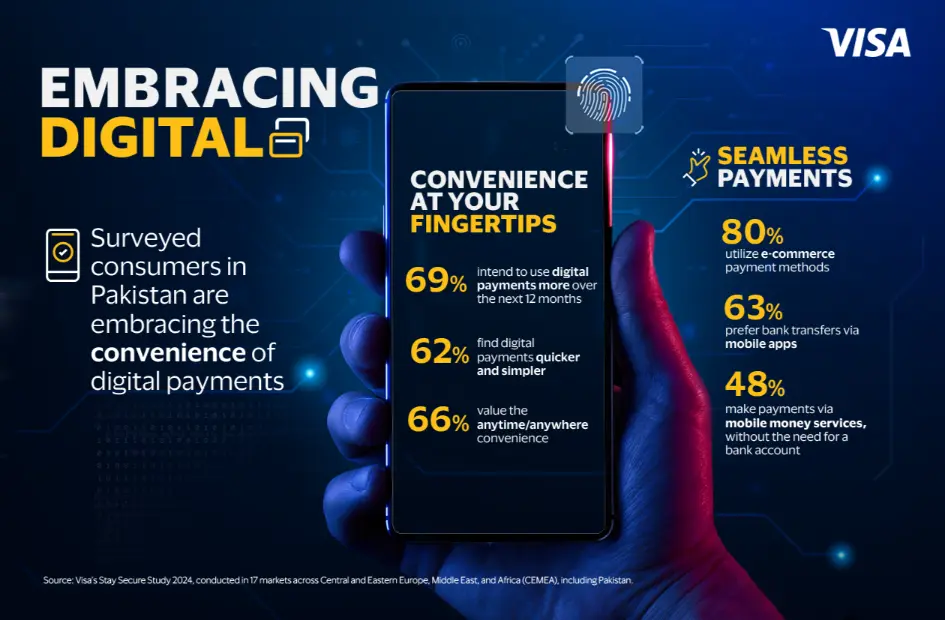
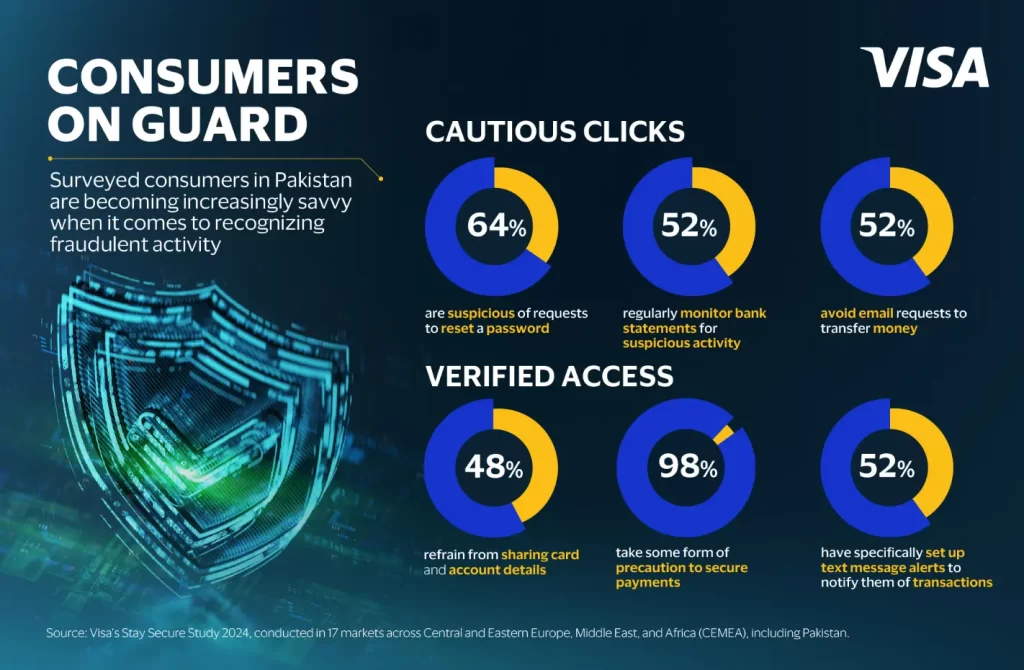
    A new study commissioned by Visa reveals a rise in consumer awareness and proactive security measures for digital payments across Pakistan. The latest edition of Visa’s Stay Secure study, which surveyed 500 adults in the country, found that 98% of consumers now actively taking precautions to secure their online transactions, showcasing increased savviness as digital payments gain momentum.

    While 55% of respondents in Pakistan acknowledge their vulnerability to scams like phishing, the increased adoption of security measures and preference for stronger authentication indicate a positive shift in consumer behavior since the last edition of the Stay Secure study in 2023.Consumers are now actively spotting red flags and verifying the legitimacy of online interactions, showing a marked increase in awareness.

    Other key insights from the research indicate the continued acceleration of digital payments across the region, with over three-quarters of all respondents stating that they mostly or completely trust digital payments, regardless of the threat of fraud. As digital payments grow in use and popularity, there are steps that retailers, banks and payments processors can take to promote even greater trust, the study states.

    Leila Serhan, Senior Vice President & Group Country Manager for North Africa, Levant & Pakistan, said: “The latest edition of Visa’s Stay Secure study affirms an increasingly sophisticated consumer base in Pakistan, one that is aware of potential security threats and actively engaged in safeguarding their digital transactions. This proactive approach, coupled with their sustained high trust in digital payments, even amidst fraud concerns, speaks volumes about the value and convenience digital payments offer across Pakistan. Visa’s ongoing efforts in consumer education are fundamental to maintaining and strengthening this trust. However, the threat of online scams is ever present and therefore it is important for consumers to remain vigilant.”

    Key Findings of the Visa Stay Secure Study:

    Susceptibility to Scams: 93% of consumers believe their friends or family would fall for a potential scam, especially if it’s a text message asking them to verify account information (56%).

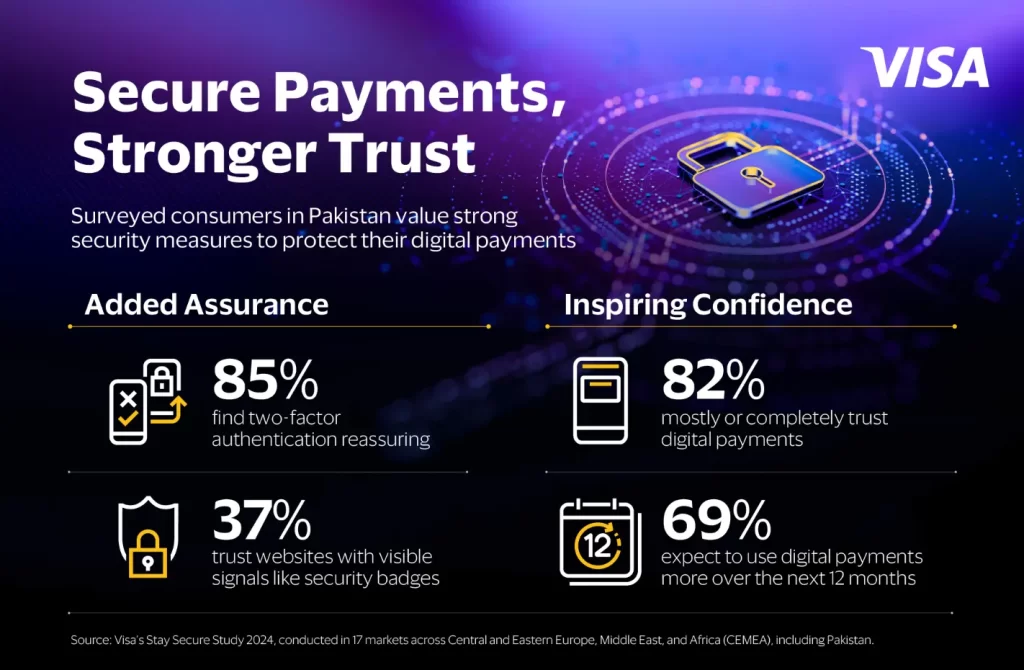
    Building Trust: Around 82% of respondents surveyed mostly or completely trust digital payments for making transactions. In fact, 85% Pakistanis feel more secure when required to enter a texted code or click on a link from the vendor to confirm their identity when making online payments.

    Digital Payments Gain Traction: Consumers in Pakistan view these types of payments as quicker and simpler than other methods (62%) and appreciate that they allow them to make payments anytime, anywhere (66%).

    Recognizing Scams: 45% of respondents consider themselves very or extremely knowledgeable when it comes to recognizing frauds and scams, a dip from 56% in the previous edition of the Stay Secure Study.

    Ease of Use: 66% of Pakistani consumers value the anytime/anywhere convenience of digital payments. Overall, 69% intend to use digital payments more over the next 12 months.

    The Stay Secure study is a part of Visa’s annual Stay Secure campaign, which reflects Visa’s commitment to raising consumer awareness, strengthening education, and building confidence to combat social engineering threats.

    Visa’s Commitment to a Secure Digital Future

    Visa has been at the center of AI in payments, investing $3.3 billion in AI and data infrastructure over the last decade. In 2024, it introduced three new AI-powered risk and fraud prevention solutions, as part of the Visa Protect suite, that are designed to help reduce fraud across immediate A2A and card-not-present (CNP) payments, as well as transactions on and off Visa’s network.

    As the world’s largest SaaS platform, Visa combats cybercrime by deploying cutting-edge tools, expertise, and processes to help identify and mitigate fraud. The impact is undeniable: In the past year, Visa blocked $40 billion in fraudulent payment value prevented 80 million fraudulent transactions, and averted over $122 million in estimated e-commerce fraud through malware detection.

    Also Read: Data Vault Launches the Pakistan’s First AI Data Center 

  • Sindh Bank selects PTCL to enhance Bank’s Digital Connectivity Infrastructure

    Pakistan Telecommunication Company Limited (PTCL) and Sindh Bank have signed an agreement for deployment of SD-WAN (Software-Defined Wide Area Network) at 330 branches of Sindh Bank. SD-WAN is a smart way for businesses to manage internet and network connections across different locations. It helps make data travel faster, more securely, and at lower cost by using software instead of just hardware.

    Syed Assad Ali Shah, Deputy CEO, Sindh Bank and Asif Ahmad, Group Chief Business Solutions Officer, PTCL & Ufone 4G signed the agreement in the presence of Muhammad Anwaar Sheikh, President & CEO, Sindh Bank at a special ceremony recently held at Sindh Bank Head Office in Karachi.  Also, present at the ceremony were Basharat Qureshi Group VP Enterprise, Sayyed Imran Bukhari, Group VP B2B Strategy, Umar Farooqi, Group Director Enterprise PTCL, Adnan Siddiqui, CIO Sindh Bank, Dilshad Hussian, CFO Sindh Bank and Syed Zeeshan ul Haq, Head Infrastructure Sindh Bank, were also present on the occasion, along with other senior officials.

    PTCL is providing Sindh Bank with its state-of-the-art infrastructure and platform solutions that are equipped with latest technology & managed security.

    During the signing ceremony, Asif Ahmed, Group Chief Business Solutions Officer PTCL & Ufone 4G said, “We are pleased to sign an agreement with Sindh Bank to support them in fulfilling their business needs. PTCL, being a national company, is leading the digitalization effort across the country. Through such partnerships, PTCL continues to play its key role in the development of telecom infrastructure by providing innovative and secure solutions to the corporate sector that will further contribute towards the overall economic growth of the country.”

    On the occasion, Muhammad Anwaar Sheikh, President & CEO Sindh Bank, said, “We are pleased to sign this agreement with PTCL as our trusted partner for infrastructure platform solutions as a part of the Bank’s focus on adopting state-of-the-art and secure technology solutions for connectivity and digitalization. This partnership signifies a transformative step forward in the Bank’s approach to infrastructure, platforms and data management. By leveraging PTCL’s advanced infrastructure and telecommunications expertise, Sindh Bank aims to achieve an enhanced operating leverage, a stronger security and data protection posture, and reduced time-to-market of products and services as the Bank continues on its journey to offer a digitally enabled financial lifestyle for its customers and partners.”

    PTCL and Sindh Bank place highest level commitment to provide best-in-class services to their customers across various industries in Pakistan. This agreement is part of the growth momentum in the diverse areas of ICT and Security Solutions, which is key to a digital banking eco-system in Pakistan.

    Also Read: BYD Pakistan Introduces Test Drives Experience for Seal and Atto 3

  • Neem & Jubilee partner to power embedded payments across the insurance value chain

    Jubilee Life Insurance, Pakistan’s largest private sector life insurance provider, has entered into a strategic partnership with Neem, the country’s leading embedded finance platform, to digitise and streamline payments across the insurance value chain.

    As part of the partnership, Neem’s flagship payment solution is integrated across Jubilee Life’s digital platforms, including its website, mobile app, and agent portal, enabling customers to make premium payments via cards, bank transfers, digital wallets, and 1Bill cash channels. Additionally, Neem will support Jubilee Life’s agent network with smart, trackable payment links, simplifying customer transactions and improving collection efficiency. Real-time insights will be made available to Jubilee Life through the Neem Business Portal, enabling better visibility and financial control across all payment touchpoints.

    The collaboration aims to modernise insurance payment solutions, making transactions more accessible and efficient for policyholders, agents, and stakeholders. By leveraging Neem’s embedded financial infrastructure, Jubilee Life will enhance its customer experience and bring greater agility to its operational processes.

    Commenting on the development, Javed Ahmed, Managing Director & CEO, Jubilee Life stated: “At Jubilee Life, we are committed to creating customer-centric solutions powered by innovation. Partnering with Neem allows us to digitise our financial flows, empower our agents, and ultimately deliver a seamless and secure payment experience to our policyholders across Pakistan.”

    “Insurance is a cornerstone of Pakistan’s financial ecosystem, and we’re excited to partner with Jubilee Life in building future-ready payment infrastructure,” said Nadeem Raoof Shaikh, Co-founder of Neem. “Together, we’re not only simplifying payments, but also are collaborating with Jubilee Life to further connect with their customers in a real-time, digital-first world.”

    Also Read: Sindh Healthcare Commission Issues Permanent Licenses to Three Healthcare Facilities

  • Dun & Bradstreet Pakistan and Gallup Pakistan issue the 18th edition of their publication – The ‘Pakistan Consumer Confidence Index (CCI)’

    Dun & Bradstreet Pakistan, in collaboration with Gallup Pakistan, has released the eighteenth edition of the Pakistan Consumer Confidence Index (CCI) for Q4 FY2024-25. This report assesses consumer confidence regarding both the overall economic environment and individual financial conditions, based on interviews conducted during April–May 2025. By offering a comprehensive analysis of consumer sentiment across the country, the publication serves as a valuable tool for evaluating the current economic climate and forecasting future trends.

    The CCI report assesses consumer sentiments across four key areas: Household Financial Situation, Country’s Economic Situation, Unemployment, and Household Savings. This index offers insights into the ‘Current Sentiments’, reflecting economic shifts experienced in the past six months, as well as the ‘Future Expectations’, i.e., expected changes in the next six months.

    In its 18th edition, the Consumer Confidence Index (CCI) report presents findings based on a telephonic survey conducted in April–May 2025, encompassing 1,936 respondents. This edition provides insights into the fourth quarter of the Fiscal Year 2024-25 (FY2024-25).

    The CCI is measured on a scale ranging from 0 to 200, with 100 serving as the neutral benchmark. A score below 100 indicates consumer pessimism, whereas a score above 100 reflects optimism. The latest survey results reveal that the CCI stands at 96.2 points, marking an improvement from the previous quarter’s score of 88.1. This upward shift reflects growing optimism among consumers, particularly in their financial outlook and expectations for the future. For the first time since tracking began in 2022, the Future Confidence Index has crossed the 100-point threshold — a milestone indicating that a greater number of consumers now hold an optimistic view of the economy’s future.

    The Net Indicator for Household Income increased significantly from 98.3 to 110.0, reflecting a rise in consumer confidence regarding future income. Similarly, the Household Financial Situation registered the highest Net Indicator this quarter, with over half of the respondents expecting their financial conditions to improve or remain stable. Consumer expectations for Household Savings also improved, with 57% anticipating either stability or growth in the coming months.

    Despite improvements in financial optimism, concerns about employment persist, with 61% of respondents perceiving a rise in unemployment over the last six months. However, the overall confidence levels have improved compared to the previous cycle, with 57% of consumers expecting economic conditions to improve or remain stable.

    A demographic analysis revealed that consumer confidence improved across all segments. The highest rise in optimism was recorded among respondents under the age of 30, who showed an 8% increase in confidence compared to the previous year, followed by male respondents.


    Mr. Muhammad Zubair Qureshi, Chief Business Officer of Dun & Bradstreet Pakistan, stated,
    “The Consumer Confidence Index (CCI) report serves as a critical reference for policymakers, financial institutions, and businesses. This quarter, we have observed a continued upward trajectory in consumer confidence, supported by improvements in financial sentiment and future expectations. The fact that the Future Confidence Index has surpassed the 100-point benchmark for the first time since the launch of this report is a significant indicator of growing public optimism. However, persistent concerns around employment emphasize the need for sustained economic reforms and inclusive job creation strategies.”


    Bilal I Gilani, Executive Director of Gallup Pakistan, added, “In Q4 2025, consumer confidence has continued its upward trajectory. In fact, the Consumer Confidence Index (CCI) is now at its highest level since Gallup & Dun & Bradstreet began tracking it in 2022. For the first time, the Future Confidence Index has crossed the 100 mark — a key threshold indicating that more Pakistanis are optimistic about the economy’s future than those who are pessimistic. These are all positive and vital signs for our economic outlook.”

    Also Read: Meezan Bank and IBA-CEIF Develop Future Islamic Finance Leaders Through Second Cohort of ‘Meezan Justuju’

  • Meezan Bank and IBA-CEIF Develop Future Islamic Finance Leaders Through Second Cohort of ‘Meezan Justuju’

    Meezan Bank, Pakistan’s Premier Islamic bank, has successfully concluded the second batch of ‘Meezan Justuju – A Quest for Islamic Finance Leaders!’, an educational initiative conducted in collaboration with the IBA Centre for Excellence in Islamic Finance (CEIF).  As part of the Bank’s broader CSR commitment, this program is designed to create meaningful learning opportunities for young graduates, equipping them with the knowledge and values needed to become future leaders in the Islamic finance sector. It reflects Meezan Bank’s on-going investment in human capital development by offering a structured pathway into the Islamic finance industry through specialized training and mentorship.

    The graduation ceremony for Batch 2 was held in Karachi and was attended by senior representatives from Meezan Bank, including Mr. Shayan Baig – Deputy Head of Shariah Compliance and Mr. Arsalan Ahmed Khan – Head of Talent Acquisition and Digital HR Solutions. Prior to this, certificate distribution ceremonies were held in Lahore and Islamabad to recognize and celebrate the achievements of the participants.

    Following the success of its inaugural batch, which was held exclusively in Karachi, the second cohort of Meezan Justuju was expanded to include Pakistan’s three major cities: Karachi, Lahore, and Islamabad. The program featured 42 hours of specialized training, blending core Islamic finance principles with essential banking knowledge; enabling participants to take a confident step toward a meaningful career in the Islamic financial sector.

    Islamic banking in Pakistan has reached remarkable scale, with a nationwide network of 6,093 branches, an asset base exceeding PKR 11.5 trillion and a deposit base of PKR 8.4 trillion. This continued momentum is driven not only by strong domestic adoption but also by growing international interest, due to the sector’s alignment with responsible investment practices and its appeal to value-conscious markets. In this context, Meezan Justuju emerges as a timely and strategic platform that is nurturing talented, values-driven talent pool ready to lead and contribute meaningfully to this evolving financial landscape.

    Also Read: Meezan Bank & IBA-CEIF jointly hold a graduation ceremony for Meezan Justuju, Islamic Finance Talent Development Program