Blog

  • The world’s largest international airline clinched top spot with a score of 88.4%, and is the only airline featured on the top 10 global list

    Emirates, the world’s largest international airline, has topped the rankings as YouGov’s Most Recommended Global Brand for 2025, a testament to the airline’s longstanding ‘Fly Better’ promise. Emirates is the only airline to be featured on the global top 10 list.

    The YouGov Most Recommended Brands rankings measure the percentage of a brand’s customers who would recommend it to a friend or colleague. This year, Emirates achieved an outstanding score of 88.4%, with a significant lead on the next closest brand. Fuelled by insights from YouGov BrandIndex, Recommend scores are based on over a million customer surveys in 28 markets, tracking brand performance daily between June 1, 2024 and May 31, 2025. Positive Recommend scores for each top 10 global brand are aggregated and weighted by the size of the brand’s current customer base per market.
    Emirates

    Sir Tim Clark, President Emirates Airline, said, “This recognition underscores the deep connection and loyalty we’ve built with passengers all over the world, who trust us not only to get them to their destination, but to do so with care, reliability, and excellence.  We will continue to evolve our already exceptional experience and set new benchmarks in travel to ensure Emirates is always a brand that our customers are proud to recommend.”

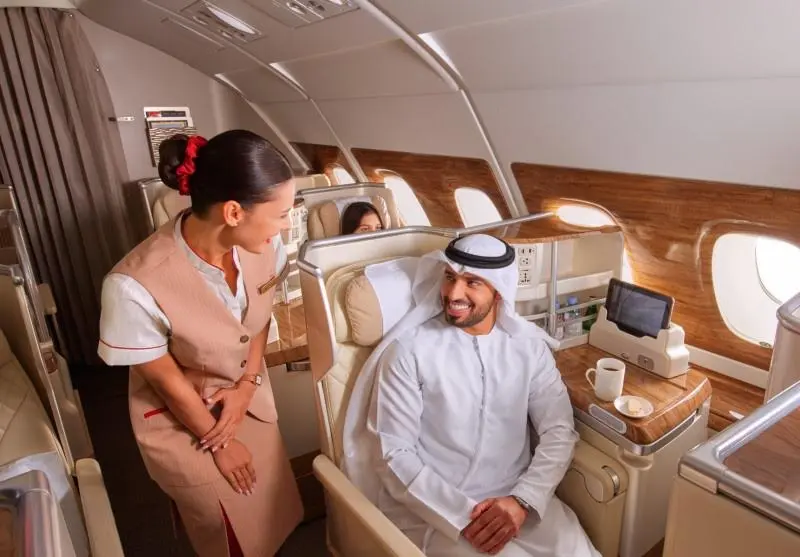
    Emirates has always kept customers at the heart of its operations, providing memorable journeys at every touchpoint, every time. Continually investing in the finest products and exceptional signature services, the airline provides a world-class travel experience in-air and on-ground.

    In the first half of 2025, Emirates expanded its global network with route launches to three new destinations, with Hangzhou to follow; inaugurated nine reimagined travel retail stores in Asia, Africa and Europe; introduced its newest aircraft type, the A350, to 10 destinations; and achieved its designation as the world’s first Autism Certified Airline™, making significant headway on its journey to make travel accessible to all.

    And Emirates shows no signs of slowing down.

    By December 2025, the airline will serve over 70 cities with aircraft fitted out with the latest interiors on Boeing 777s, A380s and A350s, representing almost 50% of its network, and offer over 2 million Premium Economy seats, enabling more travellers to enjoy Emirates’ latest generation premium onboard experience.

    Emirates

    Emirates has been recognised by YouGov before, as the most recommended brand in the UAE in the Recommend 2024 rankings with a score of 92.6. In YouGov’s 2024 US airlines report, Emirates recorded the “most satisfied customers amongst US flyers” and was one of the top 10 airlines considered by US Millennials and Gen Zs. As an international online research data and analytics firm, YouGov pioneers accessible and neutral market research and consumer interest surveys, utilising its flagship tracking tool, YouGov BrandIndex.

    Also Read: PM’s Digital Youth Hub to facilitate freelancers countrywide 

  • PM’s Digital Youth Hub to facilitate freelancers countrywide 

    Prime Minister’s Digital Hub, a government’s initiative to promote digital transformation through youth empowerment, has decided to extend its facilitations to freelance community as part of its objective raise a digital workforce within the country to drive the national economy.

    Chairman Rana Mashhood Ahmad Khan has met Chairman Pakistan Freelancers Association (PAFLA) Ibrahim Amin recently in Islamabad.

    He told the PAFLA Chairman about the government initiatives to launch various skill development and capacity building programs for youth to build a digital workforceu to drive the national economy.

    He reiterated that the government is working to establish 250 e-Rozgar Centres across the country aimed at facilitating skilled professions, including blue, white, and beyond.

    Pakistan’s Digital Youth Hub connects young people to jobs, education, entrepreneurship, and more. Developed through the partnership between PMYP and UNICEF, this initiative empowers youth to explore, grow, and lead their future.

    Chairman PAFLA Ibrahim Amin shed light on the emerging concept of digital and freelancing workers within the country, including increasing opportunities for skilled youth and their contribution in the national economy.

    He mentioned that over 2.3 million freelancers are active in Pakistan generating over half a billion dollars foreign exchange for the country but there is potential to double the number of freelancers and their contribution to the national kitty in collaboration with the government and relevant stakeholders.

    He urged the policymakers to bring different international payment gateways in the country to facilitate freelancers and remote workers, and provide various incentives to this community through commercial banks to promote cashless economy within the country.

    Officials from PSEB, Ignite and Ministry of IT and Telecommunication, Universal Service Fund (USF) were also present in the meeting.

    Also Read: National Foods Launched Second Edition of National Foodpreneur with MasterClass Pakistan

  • National Foods Launched Second Edition of National Foodpreneur with MasterClass Pakistan

    Continuing its commitment to purpose-driven impact, National Foods Limited, in collaboration with MasterClass Pakistan, launched the second edition of the National Foodpreneur Program—a transformative initiative designed to empower aspiring chefs through internationally recognized culinary certification.

    Building on the success of its inaugural cohort, National Foodpreneur 2.0 will welcome 20 students, selected based on merit and eligibility criteria, for an immersive training experience culminating in the Certificate in Culinary Artistry (CICA) – an internationally recognized qualification.

    The program aims to provide comprehensive skill development training, leading to enhanced opportunities for employment or self-employment, while contributing to empowerment and national development.

    “National Foodpreneur is about the love of good, healthy food,” said Mr. Zahid Majeed, Chairperson of the Board of Directors, National Foods Limited. “As a leader in food tradition, National Foods preserves and continues to evolve its proud culinary heritage. With a rich legacy of over 50 years, National Foods continues with the vision of creating food that enriches the lives of people everywhere – with excellence, emphasizing on nutrition and hygiene, and empowering aspiring chefs, especially women. Building on a successful pilot, National Foodpreneur 2.0 solidifies our commitment to socioeconomic uplift and community development.”

    The first cohort saw a remarkable participation of females with fifteen out of nineteen students being female, a testament to the growing interest and representation of females in the culinary and hospitality sector, creating inclusive career pathways. Six of the graduates are running small businesses as home chefs, two are presently working at NFL while five graduates are working as interns at reputable organizations, popular restaurants, and hotel chains in Pakistan.

    As part of its commitment to inclusion and accessibility, National Foods will award full scholarships to five deserving students out of the twenty, to promote youth equal opportunities for professional growth in the food and hospitality industry.

    With rising challenges around employment and economic participation in Pakistan, this program stands out as a sustainable investment in human potential, cultivating a new generation of skilled professionals who will drive economic inclusion, innovation, and self-reliance forward.

    Also Read: LUMS Celebrates the Class of 2025 at the Convocation

  • LUMS Celebrates the Class of 2025 at the Convocation

    LUMS commemorated the achievements of its graduating Class of 2025 through a series of memorable ceremonies held over two days. Degrees were conferred upon over 1,400 graduates across the University’s five schools, celebrating the excellence and hard work of both undergraduate and graduate students. They were joined by their families, friends, and faculty as they marked this major milestone.

    The convocation was graced by prominent members of the University’s leadership, including Pro Chancellor Mr. Abdul Razak Dawood, Vice Chancellor Dr. Ali Cheema, members of the Board of Trustees, Deans, and distinguished faculty members. Together, they honoured the academic accomplishments of the students and paid tribute to their perseverance and dedication.

    In his address, Vice Chancellor Dr. Ali Cheema congratulated the graduating class and welcomed them into the global LUMS alumni community. He shared words of encouragement as the graduates prepared to embark on new personal and professional journeys, “If this year has taught us anything, it is that we must build the capacity to live with uncertainty and grow stronger through it. I just want to say to you: let the winds of uncertainty fuel your fire, not extinguish your spirit.”

    The valedictorians, Aizaz Arif and Jovera Shakeel, reflected on their transformative journeys at LUMS, sharing key moments that shaped their academic and personal growth. Speaking on behalf of the class, they expressed sincere gratitude for the opportunity to learn alongside some of Pakistan’s brightest minds and acknowledged the life-changing impact of a LUMS education.

    This year’s keynote addresses were delivered by two distinguished speakers: internationally acclaimed author Ms. Kamila Shamsie and Chairman of Systems Limited, Mr. Aezaz Hussain. Ms. Shamsie encouraged graduates to pursue what they love, even when it’s hard. She shared her near-drowning experience to highlight the importance of recognizing danger early and seeking help. Emphasizing practicality over inspiration, she reflected on women’s struggles, the value of independence, and the need for self-belief.

    Mr. Hussain urged the graduates to think innovatively and lead with integrity. He also offered the graduates valuable insights and guidance, “Follow your passion, find what energizes you, what ignites your mind, speaks to your soul – and pursue it. Because when you do that, you will never run out of motivation. You will enjoy the journey and that makes all the difference.”

    Also Read: CP Fund Delay and Promotion Freeze Put KP TEVTA at Risk of Administrative Collapse

  • CP Fund Delay and Promotion Freeze Put KP TEVTA at Risk of Administrative Collapse

    The employees of KP Technical Education and Vocational Training Authority (TEVTA) are facing growing concerns over the department’s failure to deposit its share of the Contributory Provident (CP) Fund, as mandated under the KP TEVTA Contributory Provident Fund and Gratuity Rules, 2019.

    Under this regulation, both the employee and department are required to contribute 10% each towards the CP Fund. While employee deductions have continued, the department has not deposited its 10% share since 2023, leading to serious financial insecurity for staff.

    This violation is in direct conflict with the KP TEVTA CP Fund Act, which was introduced to safeguard the retirement savings and financial well-being of public servants.

    Adding to the concern is the ongoing freeze on promotions, which has left thousands of employees stuck in the same grades for years. Analysts warn that this could trigger an administrative vacuum in the near future.

    A senior official, on the condition of anonymity, stated: “By the end of 2028, nearly 80% of TEVTA’s civil servants will have retired. Without promotions and succession planning, key posts in administration and instruction will remain vacant, severely affecting governance.”

    Due to this stagnant environment, the department is witnessing an alarming brain drain, as highly skilled engineers and PhD holders are leaving KP TEVTA for better opportunities in the private sector and abroad.

    A senior academician commented:

    “It’s disheartening to see institutions meant to train and uplift the workforce crumble from the inside. Without reforms in promotion policy and financial accountability, the entire vocational system is at risk.”

    Despite repeated appeals by employees and stakeholders, the concerned authorities have yet to take meaningful action.

    The current situation, if not addressed promptly, threatens not only the morale of the workforce, but also the quality of technical education and training across Khyber Pakhtunkhwa.

    Also Read: Govt keen to facilitate overseas Pakistanis in Gulf countries via PayPak: Rana Mashhood

  • Govt keen to facilitate overseas Pakistanis in Gulf countries via PayPak: Rana Mashhood

    The federal government is keen to facilitate overseas Pakistanis and Pakistani youth in Gulf countries, mainly by providing a technological solution that enables them to send remittances to their families with ease through a domestic payment scheme, PayPak.

    This was stated by Rana Mashhood Ahmad Khan, Chairman Prime Minister Youth Programme (PMYP), in a meeting held with stakeholders recently in Karachi, including Ibrahim Amin, Chairman of PAFLA, and Najeeb Agrawalla, CEO of 1LINK.

    The federal government is working extensively to serve Pakistanis in the country and overseas by addressing their core issues through all innovative, technological, and affordable means. In this regard, the government is keen to explore strategic collaboration on empowering overseas Pakistani youth through digital remittance services and expanding PayPak’s reach under the Prime Minister’s Youth Programme, he said.

    A significant number of overseas Pakistanis comprise youth and they are assets of the country because of their commendable role in contributing to the economy of the country, hence, the PM Digital Youth Hub is exploring various options to honor their services for the
    nation with dedicated facilities and offerings, Chairman PMYP said.

    Commenting on the occasion, CEO – 1LINK Najeeb Agrawalla said, ” We aim to take initiatives to facilitate secure and structured remittance flows from non-resident Pakistani workers, especially those based in Saudi Arabia, UAE and other Gulf countries, while also promoting the use of PayPak for Hajj, Umrah, and other cross-border transactions
    including 1BILL service for non-resident Pakistanis.”

    As a major payment service provider, 1LINK proposed extending its technological expertise and platform capabilities to support the development and implementation of both initiatives, he said.

    PAFLA Chairman Ibrahim Amin highlighted that over 4 million Pakistanis reside in Gulf countries and strive to contribute honestly to the national economy through their hard-earned income. Unfortunately, many of them lack access to reliable and user-friendly technological payment solutions.

    PAFLA, in collaboration with Pakistani diplomatic missions, Pakistan’s banks, and different agencies, will do its best efforts to approach freelancers, blue- and white-collar Pakistani workers through outreach and engagement efforts across Gulf countries, he added.

    Pakistan received over $38.3 billion in remittances from different countries in the financial year 2024-25. Overseas Pakistanis residing in different Gulf countries contribute a major share to the remittance values.

    Also Read: Meezan Bank and The Hunar Foundation Join Hands Under ‘Meezan Justuju’ to Bridge the Skills-to-Job Gap for Pakistani Youth

  • Meezan Bank and The Hunar Foundation Join Hands Under ‘Meezan Justuju’ to Bridge the Skills-to-Job Gap for Pakistani Youth

    Meezan Bank, Pakistan’s first and largest Islamic bank, has signed a Memorandum of Understanding (MoU) with The Hunar Foundation (THF), a Not-for-Profit Organization (NPO) working to empower marginalized youth with vocational and technical skills to bridge the skills-to-job gap for Pakistani youth. The partnership falls under the umbrella of ‘Meezan Justuju’, the Bank’s flagship Corporate Social Responsibility (CSR) program focused on education, employment, and economic empowerment.

    The MoU was signed by Syed Amir Ali, Deputy CEO – Meezan Bank, and Mr. Tahir Jawaid, CEO – The Hunar Foundation, at a ceremony attended by senior representatives from both organizations.

    The program equips participants with market-relevant technical skills, enabling employment and financial independence while also contributing to Pakistan’s socio-economic growth.

    Since early 2024, Meezan Bank has continued to expand its Meezan Justuju initiative, building on previous partnerships with institutions like IBA CEIF (for Islamic Finance certification course) and NED Academy (for IT certification courses). The collaboration with THF marks another milestone in the Bank’s mission to support youth through targeted training and employment programs. It will benefit over 150 trainees in the current year alone, helping reshape the national landscape of skill development, employability, and social inclusion.

    Since its inception, Meezan Justuju has trained over 600 individuals, with many participants successfully entering the workforce within a short period—reinforcing the program’s success as a catalyst for financial empowerment and workforce integration. The partnership with THF aligns with national priorities to harness Pakistan’s growing youth population by building capacity through vocational training and has the potential to convert the country’s demographic potential into a productive economic asset.

    Speaking at the signing ceremony, Syed Amir Ali, Deputy CEO of Meezan Bank, stated:
    “With over 240 million people in Pakistan — 65% of whom are under the age of 30 — our youth represent the Nation’s greatest asset. Through this initiative, we aim to channel that potential toward sustainable economic development.

    By joining hands with The Hunar Foundation, we are not only enabling young individuals to access local and international employment opportunities, but also contributing to the long-term prosperity of Pakistan. We believe these empowered individuals will go on to inspire change, uplift communities, and help shape a stronger, self-reliant future for our country.”

    Sharing his views on the collaboration, Mr. Tahir Jawaid, CEO of The Hunar Foundation, added:
    “We are truly grateful to partner with Meezan Bank in its mission to uplift communities through sustainable initiatives. Together, we aim to equip underserved individuals with the skills and knowledge they need to thrive in today’s competitive world. This collaboration is not just about training – it’s about transforming lives and building a prosperous and poverty-free Pakistan.”

    Also Read: Khushhali Bank joins SBP initiative for WMSMEs

  • Khushhali Bank joins SBP initiative for WMSMEs

    Khushhali Microfinance Bank has signed the Women Entrepreneurs Finance Code (WE Finance Code) initiated by the State Bank of Pakistan (SBP) and the Asian Development Bank, aligning with a vision of a more inclusive financial system ecosystem across the country for women entrepreneurs.

    The code aims to set provide a yardstick for financial institutions nationwide to encourage women-friendly financial services in order to empower more women with safe and secure financial assistance.

    Signed by Aameer Karachiwalla, President and CEO of KMBL, the code comes as a much-needed development in the country’s attempts to bridge the gender disparity gaps and facilitate women with accessible and simplified financial solutions, including loans programs, advisory services, investment opportunities, among others. 

    Commenting on the event, Aameer Karachiwalla, President and CEO of KMBL said, “We firmly believe that a women-friendly financial network is the best way to drive the country towards economic prosperity. Across our rural and urban areas, we are eager to ensure our women clients are always well-served and are able to navigate their financial matters as fruitfully as possible.”

    Khushhali Microfinance Bank offers a specialized category of banking services equipped for women customers in order to empower women to set up their own financial journeys with reliable support and benefits.

    Also Read: MG Official Urges Industry to Rethink Pricing and Real Benefits for Consumers

  • MG Official Urges Industry to Rethink Pricing and Real Benefits for Consumers

    As Pakistan unveils its long-awaited New Energy Vehicle (NEV) Policy 2025–30, aimed at reducing emissions and fuel dependence, voices from within the auto industry are calling for a shift in how new technologies are priced and positioned in the market.

    In a recent interaction with media in Lahore, Syed Asif Ahmed, General Manager Marketing Division at MG Motors, said that while the policy is a step in the right direction, the local Hybrid Electric Vehicle (HEV) market remains largely unaffordable and does not pass on the benefits of technological advancements to the average Pakistani consumer.

    “HEVs in Pakistan have become a luxury for a niche market,” Ahmed remarked. “Despite policy support, the real advantages have not trickled down to car buyers.”

    He noted that the most expensive HEV SUV in Pakistan—a seven-seater—carries an ex-factory price tag of Rs 16 million, while five-seater variants range from Rs 9.6 to 12 million.

    “The industry must think seriously about affordability,” he added, “and consider shifting toward Plug-in Hybrid Electric Vehicles (PHEVs), which are better suited for urban use and offer real electric range.”

    Unveiled by the Ministry of Industries, the NEV Policy 2025–30 introduces official classification for EVs, PHEVs, and hydrogen-powered vehicles as “New Energy Vehicles”—in line with global standards.

    Ahmed was also critical of how earlier tax incentives were structured, allowing traditional hybrids to be labelled as “New Energy Vehicles”, primarily to benefit large automotive players.

    “Unfortunately, these subsidies neither helped the environment nor the people. They only benefited the principal companies and their local partners.”

    In contrast, PHEVs offer a more meaningful alternative, with pure EV driving capabilities for daily urban commutes and hybrid flexibility for long routes—helping tackle the range anxiety often associated with EVs.

    MG Motors has taken a lead with the introduction of Pakistan’s first locally assembled Plug-in Hybrid SUV, the MG HS PHEV. It features a 16.6kWh lithium-ion battery offering over 52 km of electric-only range, combined with a 1.5L turbocharged engine to deliver 260 HP and 370 Nm of torque—achieving 0–100 km/h in just 7.1 seconds.

    Priced under Rs 10 million, Ahmed described the MG HS PHEV as “the best value-for-money vehicle in its class,” offering advanced tech, performance, and fuel economy.

    Asif informed that MG has sold more than 16,000 vehicles in Pakistani market so far out of which approximately 2000 were Plug In Hybrid vehicles (PHEV) as Pakistani customers are realizing the true economic benefit of PHEV as it’s a perfect urban mobility option for the urban consumers.

    He says despite the changing trend of converting to PHEV from HEV Pakistani consumers have just one choice in the shape of MG HS PHEV, although having a better technology but still placed lower than most hybrids in Pakistan.

    Asif said that MG leads specification leadership in Pakistan. All automakers now follow the global specs MG introduced in MG HS in both CBU & CKD. MG vehicles have crossed approximately 350 million miles since its launch in Pakistan in 2021, and MG HS has successfully tested for Pakistan’s fuel, terrain (road), and weather conditions, he added.

    Asif said the vehicles in Pakistan are still expensive. Globally, hybrid vehicles deliver financial value when their purchase price does not exceed more than 10% of the cost of an equivalent petrol vehicle.

    However, this benchmark is not practised in the Pakistani market. Here, the price gap between hybrids and their petrol counterparts is significantly wider averaging around 45%.

    For example, a C SUV hybrid vehicle costs up to Rs 12 million, while similar C SUV conventional petrol cars cost Rs 8.0 million. In Pakistan, the difference of price between hybrid and conventional petrol cars is approximately 4.0 million in the C SUV category.

    While Pakistan’s NEV policy sets a progressive roadmap, industry execution remains key. With more PHEV models expected to enter the market, the question remains will automakers use these incentives to empower consumers—or repeat the hybrid playbook of high margins and minimal environmental gains?

    “The potential is enormous,” Ahmed concluded. “But only if we prioritize real consumer value and environmental impact—over short-term profits.”

    Also Read: Pakistan’s new National Fisheries and Aquaculture Policy unveiled

  • Pakistan’s new National Fisheries and Aquaculture Policy unveiled

    Federal Minister for Maritime Affairs, Muhammad Junaid Anwar Chaudhry on Wednesday said that under the visionary leadership of the Prime Minister, Pakistan has achieved a historic milestone by launching its first-ever national consultation for the National Fisheries and Aquaculture Policy 2025–2035, uniting key stakeholders from across the country to chart a cohesive direction for the sector.

    Federal Minister expressed these views while addressing a workshop here organized by the Ministry of Maritime Affairs with technical support from the Food and Agriculture Organization (FAO), on shaping the National Fisheries and Aquaculture Policy 2025–2035, said a press release.

    Junaid noted that despite Pakistan’s rich marine and inland water resources, the fisheries and aquaculture sector has long remained underdeveloped and underutilized.

    He pointed out that the sector currently contributes less than 0.5% to the national GDP and captures limited value from both domestic and export markets.

    The minister stressed that one of the key priorities of the new policy is fostering federal-provincial harmonization. Junaid emphasized that the Ministry of Maritime Affairs will continue to lead on critical national issues, including fulfilling international obligations and enhancing seafood exports.

    The policy also focuses on cross-cutting priorities such as climate resilience, environmental protection, child safety, gender inclusion, labour rights, and the adoption of modern technologies, minister added.

    The minister described the policy as a foundational and evolving framework whose success depends on sustained commitment, effective coordination, and active engagement from all stakeholders across the country.

    He said this policy represents a major milestone for not just the ministry but for all institutions, communities, and stakeholders committed to the future of Pakistan’s blue economy.

    Secretary of Maritime Affairs, Syed Zaffar Ali Shah stated that despite Pakistan’s long coastline, the fisheries sector has not yet achieved its potential. It remains a vital source of livelihood but faces serious issues like overfishing and poor regulation. He noted that the newly introduced national policy aims to resolve these challenges through coordinated planning. With better management and value addition, the sector could generate up to $10 billion in value.

    Florence Rolle, FAO Representative, stressed the need for strong coordination between provincial and federal governments and across sectors. She highlighted that inclusive seminars were conducted nationwide, helping shape the policy.

    Rolle praised Balochistan’s proactive development of its fisheries policy and noted that sustainable practices could attract international climate funding.

    Dr Syed Murtaza Hassan Andrabi, Animal Husbandry Commissioner from the Ministry of National Food Security emphasized that the final policy must be both ambitious and feasible. He underlined the importance of stakeholder involvement, especially since fisheries are often neglected and highly climate-sensitive. The policy, he added, must reflect the diverse ecological and cultural characteristics of each province.

    FAO’s Senior Policy Specialist, Dr Kanwar Muhammad Javed Iqbal explained the policy’s main features including fiscal incentives, ecosystem conservation, women’s empowerment, safe working environments, entrepreneurship, job creation for them, and pollution control.

    He described the inclusive, step-by-step development process of the national policy, beginning with provincial consultations. He stressed that responsible resource management and effective governance are at the heart of the strategy, ensuring long-term sustainability and resilience in the fisheries sector.

    The workshop featured several panel discussions, including sessions on governance and incentives for the fisheries and aquaculture sectors, strategies for development and management of aquaculture in Pakistan, and the implementation framework and cross-cutting themes of the national policy.

    Younas Anwar from Mahigir Itehad Gwadar, Nasir Rahim Sohrabi of RCDC Gwadar, and Syed Daim Shah, President of the Aquaculture Farmers Association, also spoke at the event, which was attended by representatives from the fisheries industry of Balochistan and Sindh, along with members of academia and policymakers.

    Also Read: AKUH Wins Prestigious Platinum Award for Heart Attack Care — Third Consecutive Year