Blog

  • Mobile Phone Prices In Pakistan To Increase Soon

    The Directorate General of Customs Valuation Karachi has taken a bold step that will impact customers across Pakistan. Reports claim that there will be a noteworthy increase in customs values for importing 1,160 mobile phone models in our country. Moreover, these handsets are tipped to be of popular brands. This step will surge mobile phone prices in Pakistan.

    Mobile Phones In Pakistan Will Become More Expensive

    According to the latest ruling, mobile phone prices of famous brands, including Apple, Huawei, Samsung, and OnePlus will see a massive hike soon. Directorate General of Customs Valuation Karachi has revised custom values for major players in the industry. It will no doubt lead to an overall increase in the cost of mobile phones for customers.

    According to the Directorate’s ruling, the used and refurbished mobile phones will be assessed based on customs values. It will bring account devaluation. All bonafide passengers importing pre-owned devices will see a massive hike in mobile prices due to the updated valuation. The clearance collectorates are recommended to evaluate the other brands and models not mentioned in the ruling under Section 81 of the Customs Act, 1969. Henceforth, a reference will be forwarded to the Directorate to finalize their customs values.

    The previous Valuation Ruling was No. 1732/2023. It was in effect for about the previous nine months. The Directorate has replaced it due to its lack of reflection on the current international market conditions. The Directorate wants to emphasize the need for a more up-to-date assessment, especially mulling the end-of-life (EOL) status of some older models. Reports claim that stakeholders in the mobile phone market even requested a revision of custom values. It would not be wrong to say that the appeal aims for a reasonable and minimal devaluation of assessable customs. The main target is the older models whose existing customs values are excessively high.

    The Directorate searched for a comprehensive market, analyzing 90 days’ worth of clearance data. This step aims to align the updated values with the prevailing market conditions. It also shows the true worth of the imported mobile phone models.

    Also Read:NBP digital app is now available in Urdu
  • NBP digital app is now available in Urdu

    National Bank of Pakistan (NBP) has introduced Urdu language support in its digital app to cater to a diverse customer base across the country. The move reflects NBP’s commitment to inclusivity, ensuring accessibility for customers from all regions. The NBP Digital app offers convenient services, including card activation, secure bank transfers, and a platform for trading and investment. With this initiative, NBP aims to provide a more personalized and inclusive banking experience. The app is now available for download on major app stores, promoting seamless financial transactions in the national language.

    Also read Finance Minister Chairs ECC Meeting on Power Generation Plans with K-Electric

  • Engro Polymer chief visits FCCI

    Jahangir Piracha, Chief Executive Officer Engro Polymer & Chemicals Limited (EPCL) visited Faisalabad Chamber of Commerce & Industry (FCCI) and discussed the overall economy and various business-related issues with President Dr Khurram Tariq.

    Muzammil Sultan, former president FCCI, Madam Rabia Wafah Khan, Chief Financial Officer, Muhammad Idrees, Chief Commercial Officer, Imran Baloch, Business Head and Asad Zahid, Area Sale Manager of the EPCL were also present during this meeting.

    Also read SIEHS, CHILDLIFE sign MoU to enhance pediatric emergency, health services across Sindh


  • SIEHS, CHILDLIFE sign MoU to enhance pediatric emergency, health services across Sindh

    The Sindh Integrated Emergency & Health Services (SIEHS 1122) and the ChildLife Foundation have entered a Memorandum of Understanding (MoU) for enhancing emergency and health services across Sindh.

     The partnership will enhance the capacity of the ambulance team to handle children’s emergency during transportation. It will evolve into live-teleconsultations and addition of bubble CPAP machines in the ambulances.

     Brig. (R) Tarique Quadir Lakhiar, CEO SIEHS and Dr. Ahson Rabbani, CEO of ChildLife Foundation, signed the MOU on behalf of their organizations while provincial health minister Dr. Saad Khalid Niaz was also present.

     “SIEHS plays a pivotal role in providing free ambulance services to patients across Sindh and the partnership with ChildLife will further help in saving lives of millions of children through tele-consultations of pediatric patients who require emergency care,” said Health Minister Dr. Saad Khalid Niaz.

    Under this strategic alliance, ChildLife will support SIEHS 1122 by providing live teleconsultations for pediatric patients within SIEHS 1122 ambulances while the ChildLife will seek assistance from SIEHS 1122 in efficiently transferring patients entering the ChildLife’s network. They will mutually assist in enhancing the capacity of their respective staff through collaborative efforts in capacity building.

     “This collaboration marks a crucial milestone in our mission to provide top-notch emergency and health services to the people of Sindh,” said Brig. Tarique Quadir, Chief Executive Officer SIEHS.

    Dr. Ahson Rabbani, CEO-ChildLife Foundation, said that “This collaboration is a testimony of the innovative services ChildLife team has developed and scaled. We are honored to partner with SIEHS to share our practices and experience saving lives with this virtual emergency care model throughout the province. The partnership closes the loop as it saves cost and time for poor patients who will now be transported through SIEHS ambulance services free of cost. This will allow us to save more lives across Sindh”.

    Also read  Finance Minister Chairs ECC Meeting on Power Generation Plans with K-Electric

  • PTA gears up to devise regulations against cyber threats

    In an effort to establish a more secure and cohesive digital landscape, the Pakistan Telecommunication Authority (PTA) is leading a nationwide initiative to standardize cybersecurity regulations and frameworks.

    As outlined in the PTA Cyber-Security Strategy 2023-28, this groundbreaking effort aims to unite various sectors, ensuring a harmonized approach to cybersecurity throughout the country. The PTA, serving as a trailblazer, is not only developing cybersecurity frameworks tailored to the telecom sector but is actively engaging with regulators from diverse industries to establish standardized guidelines.

    This collaborative endeavor involves key stakeholders such as the State Bank of Pakistan, the National Electric Power Regulatory Authority (NEPRA), the National Database Registration Authority (NADRA), the Securities and Exchange Commission of Pakistan (SECP), and the Competition Commission of Pakistan (CCP).

    The necessity for such a harmonized approach became apparent as multiple sectors, including Energy, Finance, Manufacturing, Transportation, Postal services, National Digital Database/Identity, and Health, operated independently. Each sector had its own set of regulations and frameworks specific to its licensees and constituencies, leading to potential duplications and contradictions.

    According to the PTA, the detailed policy of the State Bank of Pakistan on “Information Technology Governance & Risk Management in Financial Institutions” emphasized the importance of annual reviews of information security programs, formulation of proactive cybersecurity action plans, and the establishment of comprehensive awareness programs. While commendable, such initiatives lacked standardization across sectors, necessitating a unified and standardized cybersecurity framework.

    Also read:Finance Minister Chairs ECC Meeting on Power Generation Plans with K-Electric

    Taking a proactive stance, the PTA has initiated collaborations with various regulators and signed Memorandums of Understanding (MoUs) to facilitate joint efforts in the realm of cybersecurity. This commitment to information sharing and collaborative action represents a significant step toward creating a robust defense against cyber threats.

    The move towards a unified framework is particularly crucial for telecom operators, who often operate under multiple regulators for diverse services. Adhering to a singular set of security guidelines enables these operators to contribute to a more streamlined and effective cybersecurity strategy, addressing concerns about compliance fatigue.

    According to the PTA, the unified framework not only promises to enhance efficiency in cybersecurity measures but also to fortify national security across all sectors. As Pakistan progresses towards a safer digital future, this collective effort serves as a testament to the power of collaboration in ensuring the nation’s well-being in cyberspace.

  • Finance Minister Chairs ECC Meeting on Power Generation Plans with K-Electric

    Federal Minister for Finance, Revenue, and Economic Affairs, Dr. Shamshad Akhtar presided over a meeting of the Economic Coordination Committee (ECC) of the Cabinet, today.
    The meeting was attended by the Minister for Communication, Railways & Maritime Affairs Mr. Shahid Ashraf Tarar, the Minister for Privatization Mr. Fawad Hasan Fawad, Minister for Power & Petroleum Mr. Muhammad Ali, Advisor to PM on Finance Dr. Waqar Masood, Federal Secretaries, and other senior government officials of the relevant ministries.
    ECC took up the matter of approval of the draft PPAA, ICA, TDA & Mediation Agreements to be signed with K-Electric. Ministry of Energy (Power Division) briefed the Committee on the observations made by the members of the ECC and provided the requisite additional data on the working of CPPA-G.
    After detailed discussion and deliberation, ECC decided to approve the proposal of Power Division for signing of the draft PPAA, ICA, TDA & Mediation Agreements between K-Electric & GoP Entities. ECC also directed Power Division to present the matter related to KE’s generation enhancement plan to the CCOE, which should focus on reducing the cost of electricity as well as on the resultant subsidies.
  • Artificial Intelligence (AI) in Pakistan

    Artificial intelligence stands as a pivotal technology in the ongoing digital transformation, playing a crucial role in facilitating the expansion of businesses. Recent research and market surveys indicate that by 2025, AI is poised to experience an annual growth rate of 52%. This rapid adoption is anticipated globally, spanning sectors such as national security, healthcare, logistics, and education. Notably, the World Economic Forum suggests that the developing world may witness the loss of two-thirds of jobs due to automation.

    Pakistan’s population and governmental stability face potential significant impacts from this AI-driven shift. The negative consequences of job displacement are further exacerbated by the country’s limited access to education and technology. Understanding the intricate and multidimensional nature of AI’s influence on Pakistan’s labor market requires consideration of specific industries, job categories, and governmental policies.

    Conversely, generative AI holds the potential to enhance production and efficiency, thereby benefiting the Pakistani economy. Automation of specialized tasks in manufacturing and agriculture, such as data processing and decision-making, can boost productivity and lead to economic expansion. Furthermore, the application of generative AI in developing nations like Pakistan could create new job opportunities in AI-related industries such as data analysis, software development, and machine learning, offering relief to the existing high unemployment rates. Additionally, generative AI can contribute to educational advancements by tailoring learning experiences for students, potentially improving academic achievements, and increasing access to education in developing nations.

    The positive impact of generative AI in Pakistan hinges on factors like the availability of resources (energy, internet connectivity, and a skilled workforce) and adherence to governmental rules and regulations. Given that some countries are making substantial investments in Artificial Intelligence, it is imperative for Pakistan to create an environment conducive to the application of AI and to catch up with the advancements made by developed nations.

    Also Read: ABHI has been selected as one of the Future 100 companies in the UAE

  • Engro Corporation, its listed subsidiaries recognized among top 10 recipients at PSX awards

    Engro Corporation and its subsidiaries Engro Fertilizers, Engro Polymer & Chemicals, and Engro Powergen Qadirpur, were presented the prestigious Pakistan Stock Exchange Top 25 Companies awards by the caretaker Honourable Prime Minister Mr. Anwaar ul Haq Kakar at a ceremony held in Karachi.

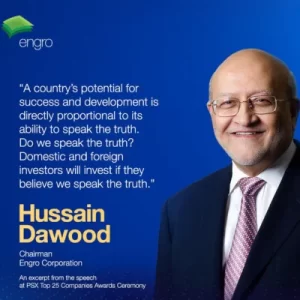
    Chairman Engro Corporation Hussain Dawood, who was invited to address the distinguished guests, appreciated the Government for recognizing the private sector’s pivotal role in Pakistan’s economy. He said that the corporate sector is fully aligned with the government’s direction to create a conducive business environment and restore investor confidence. Hussain Dawood also thanked the Pakistan Stock Exchange for playing an instrumental role in encouraging the corporate sector to excel.

    Reflecting on investor confidence, Chairman Engro Hussain Dawood said “A country’s potential for success and development is directly proportional to its ability to speak the truth. Do we speak the truth? Domestic and foreign investors will invest if they believe we speak the truth.”

    Engro Corporation

    In his speech, caretaker Honourable Prime Minister Mr. Anwaar ul Haq Kakar said he felt proud of inspiring individuals like Hussain Dawood, who is an emblem of resilience, humility, and accomplishments. He acknowledged the contributions of Hussain Dawood towards philanthropy, business landscape, and the country.

    Every year, PSX acknowledges the performance of listed companies based on a comprehensive quantitative criterion, which includes strong corporate governance, transparency, excellent financial and managerial performance, and compliance with Listing of Companies and Securities Regulations. Regarding qualitative criteria, PSX selected high-performing listed companies based on Corporate Social Responsibility (CSR), reporting on SDGs, and ESG-related initiatives including Diversity and inclusivity, among other considerations.

    Read More VIS Reaffirms ‘AA-‘ and ‘A-1’ Ratings for Engro Powergen Qadirpur Limited with Positive Outlook

  • ABHI has been selected as one of the Future 100 companies in the UAE

    ABHI, an embedded finance platform, provides innovative
    finance solutions to businesses and their employees have been selected
    as one of the Future 100 companies in the UAE.

    Future100, an initiative by the Ministry of Economy and the Government
    Development and the Future Office aimed at spotlighting the top 100
    startups contributing to the nation’s readiness for the future and the
    competitiveness of the economic sector in the UAE.

    The Future 100 Awards ceremony, held on 8th December 2023, was graced
    by the presence of H.E Abdulla Bin Touq Al Marri, UAE Minister of
    Economy, and H.E Ohood bint Khalifa Al Roumi, Minister of State for
    Government Development & The Future.

    ABHI’s Co-Founder and CEO, Omair Ansari, received the Future 100
    award. Ansari expressed his gratitude on this momentous occasion: “We
    are incredibly honored to be selected as the Future 100 company in the
    UAE. This achievement underscores our commitment to promoting
    financial wellness in the region. It’s vital to emphasize the vibrant
    potential and the incredibly supportive environment the UAE has
    provided us. We remain dedicated to financially empowering businesses
    and individuals.”

    ABHI appreciates the support of its partners including Hub71, CBI,
    DIFC, Edenred, ADIO, and UAE for providing it with a platform to
    amplify its mission globally.

    ABHI stands at the forefront of financial innovation, with this
    distinguished recognition solidifying its pivotal role in shaping the
    the future landscape of economic development. The company’s commitment to
    excellence and contributions to the financial sector are poised to
    pave the way for continued innovation.

    Also Read: Zood opens waitlist for ZoodCard, Pakistan’s first Buy-Now-Pay-Later card, powered by Mastercard

  • Zood opens waitlist for ZoodCard, Pakistan’s first Buy-Now-Pay-Later card, powered by Mastercard

    Zood, a leading digital lending platform for e-commerce in the Middle East and Central Asia, announced today that its waitlist for ZoodCard is now open to all Pakistan consumers. Powered by Mastercard, ZoodCard is Pakistan’s first Buy-Now-Pay-Later (BNPL) card that will allow consumers to convert their purchases into four interest-free installments securely, conveniently, and with no fees, both online and in store.

    As an extension of the Zood experience, ZoodCard aims to foster financial freedom for its consumers amidst high inflation in the growing e-commerce sector. Featuring a transparent repayment schedule and a graduation path, ZoodCard seeks to unleash the credit potential of consumers and allow them to build sustainable credit histories over time. The card will also introduce a loyalty program to help consumers make the most of what they spend.

    Zood’s consumers can look forward to a speedy approval and issuance of the card that can be used almost everywhere Mastercard is accepted, with the peace of mind that purchases are backed by Mastercard consumer protection.

    Consumers can sign up for the waitlist via Zood’s website and register on the Zood app. ZoodCard will be issued to consumers within minutes via the Zood app upon real-time credit assessment and ID verification.

    “ZoodCard aims to empower consumers to manage their cashflows with ease. With a USD 8 billion digital credit potential in Pakistan, BNPL is growing as an avenue to financially include the masses. ZoodCard will allow us to scale our installment offerings to consumers anytime and anywhere without being restricted exclusively to the Zood network,” said Zood’s management in a statement.

    BNPL solutions offer a wide variety of benefits to merchants and shoppers alike. They contribute to enhancing financial security by enabling people to make instant purchases – especially for big-ticket items – at no extra expense. On the other hand, customers who use BNPL tend to make repeat purchases and have higher lifetime spend, driving revenue to merchants.

    “At Mastercard, we are committed to expanding the variety of innovative payment solutions available to consumers in Pakistan and the wider region as part of our efforts to drive digital transformation and financial inclusion. With our vast acceptance and reach, we are uniquely positioned to enable lenders and merchants to deliver secure BNPL experiences at scale, empowering them to unlock new opportunities and accelerating sustainable economic growth. We are delighted to bring Mastercard Installments to the region as we facilitate access to essential products and services for individuals and businesses,” said Arslan Khan, Vice President, Country Business Manager, Pakistan, Mastercard.

    Zood’s collaboration with Mastercard as a partner will extend across multiple geographies. Mastercard will supplement this offering by providing access to its wide network of merchants, payment innovation, and state-of-the-art digital infrastructure for enablement and scalability.

    ZoodCard will be available to Pakistan’s consumers in the near future and will also be launched in Zood’s markets in Uzbekistan and Lebanon. The company is currently undergoing a limited user pilot before it makes the BNPL card available to all users.

    Also Read:Telenor concludes strategic review with sale of Telenor Pakistan to PTCL