Category: Tech

  • Mehwish Salman Ali Elected President of CxO Global Forum USA Chapter

    Mehwish Salman Ali, visionary CEO and Co-Founder of Zahanat AI and Data Vault Pakistan, has been elected President of the USA Chapter of CxO Global Forum, a leading international platform connecting global C-level executives, technologists, and thought leaders. This prestigious appointment reflects Ms. Mehwish’s extraordinary contributions to artificial intelligence, entrepreneurship, and digital transformation across borders.

    As President, Ms. Mehwish will lead initiatives that promote collaboration between global technology leaders, foster innovation ecosystems, and empower emerging markets through sustainable and inclusive digital strategies.

    “This appointment represents an opportunity to bridge technological innovation with strategic business leadership on a global scale,” said Ms. Mehwish. “I look forward to facilitating meaningful connections between technology leaders and driving initiatives that create lasting impact across industries.”

    Ms. Mehwish’s appointment marks a continuation of her impactful journey as one of South Asia’s foremost female tech leaders. She has achieved several industry firsts:

    • Launched Zahanat AI, Pakistan’s first homegrown GPT-based language model, developed with 2 billion culturally contextual parameters — making AI more inclusive, ethical, and locally relevant.
    • Founded Data Vault Pakistan, the country’s first women-led, solar-powered, and quantum-encrypted AI data center, advancing green technology and AI infrastructure.
    • Raised $10 million from JR Dallas Tech Fund to scale Pakistan’s AI ecosystem.
    • Represented Pakistan at the International Digital Cooperation Forum in Jordan, announcing the country’s first AI Innovation Center.
    • Empowered over 100 women-led startups through the SheEarns initiative — providing mentorship, visibility, and international platforms.

    CxO Global Forum Vision & Strategic Roadmap

    As President of the USA Chapter, Ms. Mehwish aims to:

    • Bridge global innovation corridors between the U.S., South Asia, and the Middle East
    • Champion AI policy dialogues, ethical tech frameworks, and public-private partnerships
    • Lead programs that accelerate AI adoption in education, smart infrastructure, and digital health
    • Expand the Forum’s network by engaging venture capitalists, CIOs, and founders across emerging markets

    Her leadership brings together deep technical insight, startup agility, and a global policy perspective — making her uniquely positioned to shape the future of the Forum’s international strategy.

    Ms. Mehwish Salman Ali is a globally recognized tech entrepreneur, AI innovator, and public speaker. A member of the Forbes Technology Council, TEDx speaker, and recipient of awards such as Wonder Women of Dubai, Who’s Who in Technology, and Azm-e-Alishan, she has led more than 100 IT projects through her leadership at 3wOgle Group of Companies.

    With a background in genetics and a career pivot to technology in 2008, Ms. Mehwish is known for building powerful cross-border partnerships, promoting digital inclusion, and creating scalable, ethical AI products. Her work aligns with UN Sustainable Development Goals, particularly in women’s economic empowerment, digital literacy, and innovation-driven growth.

    CxO Global Forum is a premier global network of C-level executives, industry leaders, and innovators from around the world. The forum serves as a think tank for exchange of ideas, fostering collaboration on cutting-edge topics including digital transformation, AI, cybersecurity, ESG, and enterprise strategy. The USA Chapter plays a pivotal role in shaping international partnerships, investments, and emerging tech narratives.

    Also Read: PTCL and Huawei enable Sukh Chayn Residence with 5G-ready connectivity
  • PTCL and Huawei enable Sukh Chayn Residence with 5G-ready connectivity
    PTCL Group (PTCL & Ufone 4G) in collaboration with Huawei, has deployed state-of-the-art connectivity solutions at Sukh Chayn Residence, a premier luxury residential complex in Islamabad, to redefine smart living. This unique collaboration combines 5G Ready Digital Indoor System (DIS) Lampsite and High-speed Fiber-To-The-Home (FTTH) with luxury living to set a new standard for digital lifestyle in Pakistan.

    The DIS represents a significant leap forward in connectivity technology, unlike traditional Distributed Antenna Systems (DAS), which rely on passive components, DIS delivers 100% digital signals through an end-to-end active infrastructure. This ensures superior coverage, minimal interference, and a unified user experience, especially in high-rise buildings, all while maintaining the aesthetic integrity of the residential space.

    Sharing his thoughts, Asif Ahmed, Group Chief Business Solution Officer, PTCL & Ufone 4G said, “This partnership reaffirms PTCL Group’s leadership in B2B solutions and the unwavering faith vested by individual and enterprise customers in the brand. This project signifies our vision for the future of connectivity in Pakistan and strengthens our commitment to deploying cutting-edge digital solutions that transforms living experience. The Digital Indoor System ensures seamless connectivity, empowering residents to effortlessly manage their daily lives and work routines, while also helping elevate lifestyles, unlock new opportunities, and drive sustainable growth and progress.”

    Muhammad Saleh Azeem, CEO, Sukh Chayn Residence, said, “We are proud to partner with PTCL Group to offer our residents an unparalleled digital living experience. Becoming the first 5G-ready residential complex testifies to our commitment to meeting the growing needs of our residents. Our forward-looking approach makes us the housing brand of the future.”

    Michael Che, Managing Director Carrier Business, Huawei stated “We are excited to introduce Huawei 5G ready DIS technology in Pakistan through PTCL that will allow their customers to experience luxury living at its finest. This technology will redefine High Speed Mobile Broadband (MBB) Connectivity for Residential Sector and will enable PTCL to be the primary internet connection provider to millions of customers across Pakistan.”

    The collaboration brings a distinctive MBB element to PTCL Group’s series of past FTTH partnerships with leading businesses, further reinforcing its position as the telecom partner of choice for Pakistan’s most respected brands.

    Also Read: Private firm develops digital framework to regulate barter trade in Pakistan

  • Private firm develops digital framework to regulate barter trade in Pakistan

    Amid persistent challenges in operationalizing barter agreements with countries such as Russia, Iran, and Afghanistan, a Karachi-based technology company has introduced a digital framework aimed at overhauling Pakistan’s barter trade mechanism.

    Galaxefi Solutions, a private tech firm specializing in digital freight workflows, has developed a national-level system called BARTMAS, Barter Trade Management System. The initiative seeks to bring transparency, efficiency, and coordination to barter-based transactions, a necessity for Pakistan given its limited banking relations with several trading partners due to sanctions and geopolitical constraints.

    Founder and CEO of Galaxefi, Asif Pervez, said the system is designed to move the country away from outdated manual processes that have made barter trade vulnerable to inefficiencies, mismanagement, and policy blind spots. “Barter trade doesn’t have to be broken,” he remarked. “We just have to stop guessing and start measuring, digitally, transparently, and in real time.”

    BARTMAS aims to integrate all key national institutions through digital APIs, including the Pakistan Single Window (PSW), Federal Board of Revenue (FBR), Ministry of Commerce (MoC), National Logistics Cell (NLC), State Bank of Pakistan (SBP), and other authorities. The proposed digital infrastructure will enable end-to-end visibility of the barter journey from the initiation of a barter request and customs clearance to escrow fund management and bonded warehousing, ensuring that each step is auditable and centrally traceable.

    According to Galaxefi, the process begins with barter requests initiated through a secure online dashboard, followed by real-time inventory checks to prevent domestic shortages. Contracts would be verified in coordination with regional chambers of commerce, such as the Quetta and Zahidan Chambers. Goods declarations would be filed digitally through PSW using a dedicated barter trade route. Licensed banks would manage escrow services under the supervision of the SBP, while cargo movement would be handled by the NLC under TIR protocols, with the entire logistics chain sealed and monitored for security. A blockchain-powered audit trail would underpin the system, ensuring transparency at every step.

    The digital framework has already been presented to relevant trade and institutional bodies, with discussions underway regarding potential adoption. Galaxefi is also working in coordination with PSW and the Pakistan International Freight Forwarders Association (PIFFA) to align its technology with national logistics and customs frameworks.

    The need for such a system is underscored by the alarming failures of recent barter arrangements, most notably the 2023–24 wheat trade debacle. In that case, barter-related mismanagement resulted in estimated losses of Rs 484 billion to farmers and the federal government within a single year. During the same period, food poverty increased from 34 percent to 39.4 percent, pushing over 12 million people into hardship. Despite a domestic wheat surplus, the government imported the commodity at a cost exceeding $1 billion, further fuelling inflation, which peaked at 38 percent.

    Experts say these failures are symptomatic of a broader structural issue, barter trade in Pakistan continues to rely on manual approvals, fragmented record-keeping, and outdated verification mechanisms. Multiple Standard Regulatory Orders (SROs) by the Ministry of Commerce have failed to establish cohesion among key stakeholders, including customs, the FBR, SBP, and border security agencies. This has led to overlapping shipments, oversupply of certain commodities, and national shortages of others.

    In such a context, Galaxefi’s BARTMAS framework offers more than just a technological solution, it presents a comprehensive policy model that could fundamentally reshape how Pakistan engages in barter trade. As Pervez puts it, “A system that can break millions must be rebuilt with millions in mind.”

    With inflation high, food insecurity deepening, and international scrutiny increasing, the case for digital reform in trade management is no longer optional. The real question now is whether the government is ready to implement the tools already available and take the bold steps needed to protect the country’s economic and food security.

    Also Read: Global Superstars Justin Timberlake and Robbie Williams to Perform Live in Istanbul

  • Pakistani receives Award of Honor for cybersecurity

    Ali Salman Syed has made history by becoming the first Pakistani to receive the President’s Award of Honor from EC-Council University, one of the world’s foremost institutions in cybersecurity education.

    The President’s Award of Honor is the highest academic recognition presented by EC-Council University. It is awarded to students who demonstrate exceptional academic performance, uncompromising ethical standards, and forward-thinking innovation in the field of cybersecurity. This award not only reflects mastery of the subject matter but also the embodiment of leadership and social responsibility in a rapidly evolving digital world.

    Ali Salman Syed is the Principal Solutions Architect for the EMEA region at Veeam Software. His achievement is a groundbreaking moment for Pakistan’s growing footprint in global technology and cybersecurity leadership. With over 18 years of experience, he has
    been at the forefront of securing enterprise systems, driving zero-trust architecture, and building resilience across Fortune 500 companies and government institutions. His leadership spans across Europe, the Middle East, and Africa, delivering innovative solutions
    that safeguard mission-critical infrastructure.

    As the first Pakistani to be honored with this award, Ali’s success represents the emergence of a new generation of Pakistani tech leaders making their mark on the global stage. His contribution to advancing cybersecurity, both academically and professionally, sets a powerful example for aspiring professionals in Pakistan and beyond.

    “Receiving the President’s Award of Honor is a moment of immense pride — not just personally, but for every Pakistani striving to make an impact in the global technology arena. This recognition reinforces the importance of academic excellence, ethical innovation, and the urgent need for strong cybersecurity leadership in today’s world,” said Ali Salman Syed.

    EC-Council University, headquartered in Albuquerque, New Mexico, is a global leader in cybersecurity education. The university is accredited by the Distance Education Accrediting Commission (DEAC) and is recognized by both the U.S. Department of Education and the Council for Higher Education Accreditation (CHEA).

    This international honor adds to Pakistan’s growing legacy of excellence in cybersecurity and tech innovation, inspiring a new wave of talent to rise and lead with vision, knowledge, and purpose.

    Also Read: Chairman of Engro, Hussain Dawood, Appreciates Enduring China-Pakistan Partnership at WEF summit with Chinese Premier, Li Qiang

  • Visa Stay Secure Study: 98% of Pakistani Consumers Proactively Secure Online Transactions

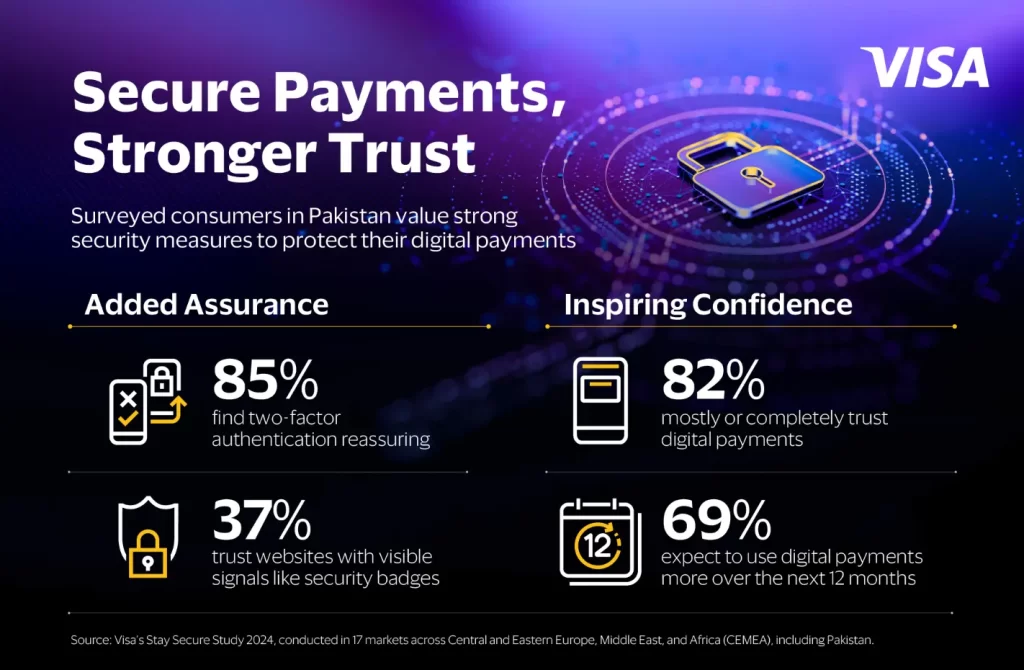
    • 82% of consumers trust digital payments despite potential scams; 69% expect to use them more in the next 12 months

    • 93% respondents worry their family, or friends might fall for a scam

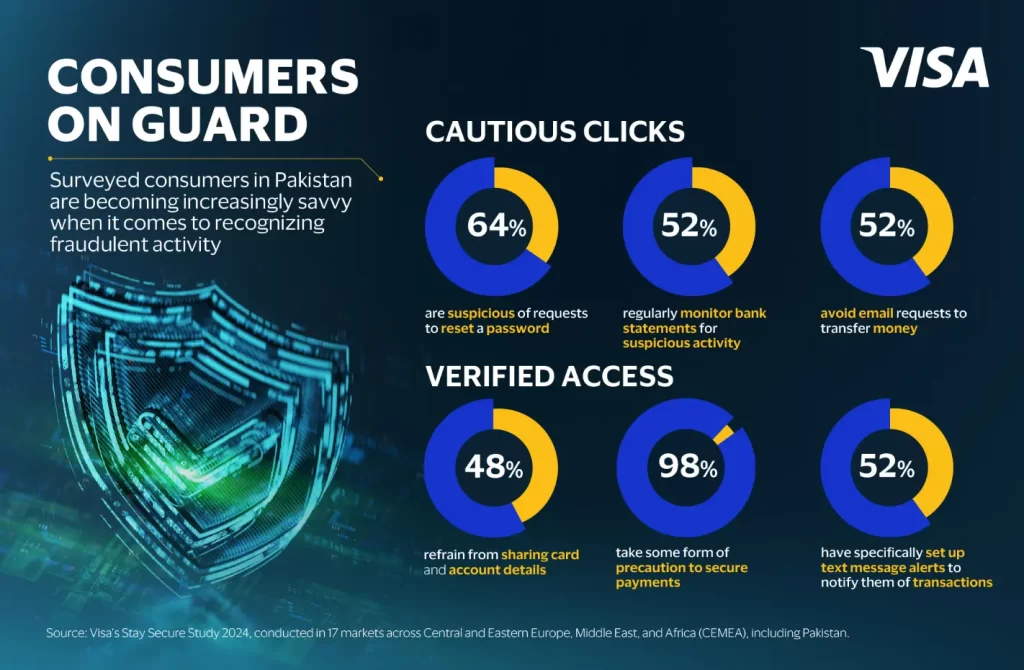
    A new study commissioned by Visa reveals a rise in consumer awareness and proactive security measures for digital payments across Pakistan. The latest edition of Visa’s Stay Secure study, which surveyed 500 adults in the country, found that 98% of consumers now actively taking precautions to secure their online transactions, showcasing increased savviness as digital payments gain momentum.

    While 55% of respondents in Pakistan acknowledge their vulnerability to scams like phishing, the increased adoption of security measures and preference for stronger authentication indicate a positive shift in consumer behavior since the last edition of the Stay Secure study in 2023.Consumers are now actively spotting red flags and verifying the legitimacy of online interactions, showing a marked increase in awareness.

    Other key insights from the research indicate the continued acceleration of digital payments across the region, with over three-quarters of all respondents stating that they mostly or completely trust digital payments, regardless of the threat of fraud. As digital payments grow in use and popularity, there are steps that retailers, banks and payments processors can take to promote even greater trust, the study states.

    Leila Serhan, Senior Vice President & Group Country Manager for North Africa, Levant & Pakistan, said: “The latest edition of Visa’s Stay Secure study affirms an increasingly sophisticated consumer base in Pakistan, one that is aware of potential security threats and actively engaged in safeguarding their digital transactions. This proactive approach, coupled with their sustained high trust in digital payments, even amidst fraud concerns, speaks volumes about the value and convenience digital payments offer across Pakistan. Visa’s ongoing efforts in consumer education are fundamental to maintaining and strengthening this trust. However, the threat of online scams is ever present and therefore it is important for consumers to remain vigilant.”

    Key Findings of the Visa Stay Secure Study:

    Susceptibility to Scams: 93% of consumers believe their friends or family would fall for a potential scam, especially if it’s a text message asking them to verify account information (56%).

    Building Trust: Around 82% of respondents surveyed mostly or completely trust digital payments for making transactions. In fact, 85% Pakistanis feel more secure when required to enter a texted code or click on a link from the vendor to confirm their identity when making online payments.

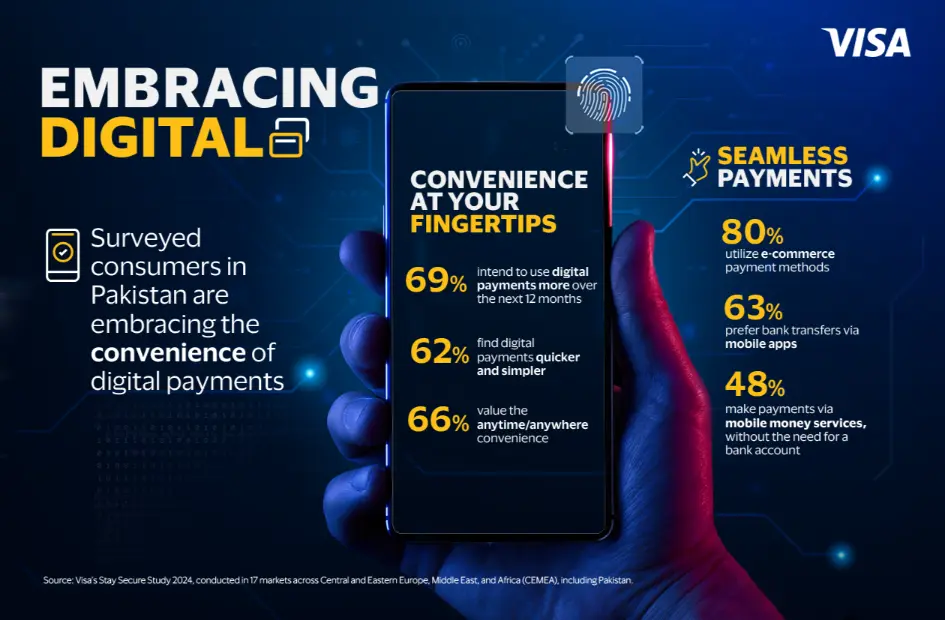
    Digital Payments Gain Traction: Consumers in Pakistan view these types of payments as quicker and simpler than other methods (62%) and appreciate that they allow them to make payments anytime, anywhere (66%).

    Recognizing Scams: 45% of respondents consider themselves very or extremely knowledgeable when it comes to recognizing frauds and scams, a dip from 56% in the previous edition of the Stay Secure Study.

    Ease of Use: 66% of Pakistani consumers value the anytime/anywhere convenience of digital payments. Overall, 69% intend to use digital payments more over the next 12 months.

    The Stay Secure study is a part of Visa’s annual Stay Secure campaign, which reflects Visa’s commitment to raising consumer awareness, strengthening education, and building confidence to combat social engineering threats.

    Visa’s Commitment to a Secure Digital Future

    Visa has been at the center of AI in payments, investing $3.3 billion in AI and data infrastructure over the last decade. In 2024, it introduced three new AI-powered risk and fraud prevention solutions, as part of the Visa Protect suite, that are designed to help reduce fraud across immediate A2A and card-not-present (CNP) payments, as well as transactions on and off Visa’s network.

    As the world’s largest SaaS platform, Visa combats cybercrime by deploying cutting-edge tools, expertise, and processes to help identify and mitigate fraud. The impact is undeniable: In the past year, Visa blocked $40 billion in fraudulent payment value prevented 80 million fraudulent transactions, and averted over $122 million in estimated e-commerce fraud through malware detection.

    Also Read: Data Vault Launches the Pakistan’s First AI Data Center 

  • Sindh Bank selects PTCL to enhance Bank’s Digital Connectivity Infrastructure

    Pakistan Telecommunication Company Limited (PTCL) and Sindh Bank have signed an agreement for deployment of SD-WAN (Software-Defined Wide Area Network) at 330 branches of Sindh Bank. SD-WAN is a smart way for businesses to manage internet and network connections across different locations. It helps make data travel faster, more securely, and at lower cost by using software instead of just hardware.

    Syed Assad Ali Shah, Deputy CEO, Sindh Bank and Asif Ahmad, Group Chief Business Solutions Officer, PTCL & Ufone 4G signed the agreement in the presence of Muhammad Anwaar Sheikh, President & CEO, Sindh Bank at a special ceremony recently held at Sindh Bank Head Office in Karachi.  Also, present at the ceremony were Basharat Qureshi Group VP Enterprise, Sayyed Imran Bukhari, Group VP B2B Strategy, Umar Farooqi, Group Director Enterprise PTCL, Adnan Siddiqui, CIO Sindh Bank, Dilshad Hussian, CFO Sindh Bank and Syed Zeeshan ul Haq, Head Infrastructure Sindh Bank, were also present on the occasion, along with other senior officials.

    PTCL is providing Sindh Bank with its state-of-the-art infrastructure and platform solutions that are equipped with latest technology & managed security.

    During the signing ceremony, Asif Ahmed, Group Chief Business Solutions Officer PTCL & Ufone 4G said, “We are pleased to sign an agreement with Sindh Bank to support them in fulfilling their business needs. PTCL, being a national company, is leading the digitalization effort across the country. Through such partnerships, PTCL continues to play its key role in the development of telecom infrastructure by providing innovative and secure solutions to the corporate sector that will further contribute towards the overall economic growth of the country.”

    On the occasion, Muhammad Anwaar Sheikh, President & CEO Sindh Bank, said, “We are pleased to sign this agreement with PTCL as our trusted partner for infrastructure platform solutions as a part of the Bank’s focus on adopting state-of-the-art and secure technology solutions for connectivity and digitalization. This partnership signifies a transformative step forward in the Bank’s approach to infrastructure, platforms and data management. By leveraging PTCL’s advanced infrastructure and telecommunications expertise, Sindh Bank aims to achieve an enhanced operating leverage, a stronger security and data protection posture, and reduced time-to-market of products and services as the Bank continues on its journey to offer a digitally enabled financial lifestyle for its customers and partners.”

    PTCL and Sindh Bank place highest level commitment to provide best-in-class services to their customers across various industries in Pakistan. This agreement is part of the growth momentum in the diverse areas of ICT and Security Solutions, which is key to a digital banking eco-system in Pakistan.

    Also Read: BYD Pakistan Introduces Test Drives Experience for Seal and Atto 3

  • Data Vault Launches the Pakistan’s First AI Data Center 

    Data Vault Pakistan has officially launched the country’s first AI-focused data center, a groundbreaking initiative set to transform how the nation builds, deploys, and scales artificial intelligence.

    This next-generation facility is designed to fuel the ambitions of Pakistan’s AI ecosystem, offering unmatched infrastructure for startups, researchers, enterprises, and government agencies. From high-performance GPU computing to secure cloud environments, Data Vault is making it possible for AI innovation to happen at home—on Pakistani soil, powered by clean energy, and protected by sovereign infrastructure.

    Mehwish Salman Ali, Founder and CEO of Data Vault Pakistan, shared: “We didn’t just build a data center—we built a launchpad for Pakistan’s AI future. Our goal is to give local innovators the tools and confidence they need to create world-class solutions, without depending on foreign platforms. This is about self-reliance, empowerment, and unleashing Pakistan’s true digital potential.”

    With Data Vault, AI startups in Pakistan can now access enterprise-grade GPU-as-a-Service to train and deploy models faster and more affordably. This means faster go-to-market times, fewer limitations on compute power, and greater independence for local founders.

    Universities and research institutes can also benefit from partnerships with the facility, tapping into scalable infrastructure that supports deep learning, academic research, and applied AI.

    At the enterprise and government level, organizations can host sensitive workloads in a fully compliant, high-security environment—ensuring data stays within the country and meets global standards for privacy and protection.

    Data Vault is built with sustainability and security at its core. It runs entirely on solar power, making it Pakistan’s first green data center purpose-built for AI. It also integrates advanced encryption and zero-trust architecture to protect sensitive workloads and critical infrastructure.

    All data is stored locally, which supports the nation’s growing focus on data sovereignty and digital independence.

    This launch comes at a time when Pakistan is accelerating its national AI strategy. With initiatives underway around AI regulation, digital public infrastructure, and indigenous GPT models, Data Vault is uniquely positioned to support this transformation from the ground up.

    By providing affordable, secure, and scalable access to computers, Data Vault is helping unlock opportunities for every entrepreneur, engineer, student, and policymaker committed to building Pakistan’s AI future.

    Also Read: Pakistan Dairy Association hosts a National Seminar to celebrate World Milk Day

  • Advergic Could Be the Most Important AdTech Update for Pakistan in a Decade

    For too long, publishers in Pakistan have worked hard and earned little. Advergic is changing that.

    Advergic is the only ad tech company in Pakistan officially partnered with Google to directly onboard publishers to Google Ad Manager (GAM). For publishers, it means what actually counts: higher earnings, full control over ad inventory, and access to global ad demand that was never in reach before.

    If you run a news website, mobile app, or any content platform, here’s what Advergic brings to the table for you:

    • Higher CPMs from real global demand that pays what your traffic is actually worth Your own ad account, your rules.
    • No more being stuck in someone else’s setup Real-time transparent reporting
    • Built-in fraud protection to prevent fake traffic from eating into your income
    • Money comes in on time. No more chasing down payments or waiting weeks
    • A team that actually picks up the phone. Local support that understands your platform & speaks your language

    100% Google-approved setup, so you can grow without fearing sudden bans or account shutdowns that kill months of work No upfront costs. Getting started is quick, clean, and doesn’t cost a rupee

    “We’ve seen talented publishers across Pakistan struggle with low revenues, zero transparency, & outdated setups that hold them back,” says Junaid Chaudhry, CEO of Advergic.

    “We didn’t wait for someone else to fix it, we built the solution ourselves. Google’s trust means publishers here can finally get the monetization that matches their hard work.”

    As Pakistan’s only Google-certified MCM Channel Partner, Advergic has already helped over 200 publishers, from national newsrooms to niche blogs and high-traffic apps, increase revenue by 30% to 400%, according to internal case studies.

    It’s all part of the vision Advergic was built on: to close the gap between the hard work publishers put in and the revenue they truly deserve.

    Also Read: Livoltek Sets New Standard in Pakistan’s Solar Industry with Best-in-Class After-Sales Services

  • PTCL, Telco Integrators, and Kacific join forces to deliver nationwide connectivity through satellite services

    Pakistan Telecommunication Company Limited (PTCL), Telco Integrators Pvt Ltd (TI), and Kacific Broadband Satellites Group have signed a Memorandum of Understanding (MoU) to collaborate on expanding high-speed satellite internet, broadband, and voice services across Pakistan.

    This strategic partnership aims to deliver integrated connectivity solutions tailored to Pakistan’s diverse geographic and infrastructural needs. By combining robust telecommunications infrastructure of PTCL, Telco Integrators’ technical expertise, and Kacific Broadband Satellites Group’s advanced satellite capabilities, the alliance aims to provide reliable, affordable, and scalable broadband solutions to underserved areas in Pakistan with the goal of contributing to the country’s digital transformation.

    PTCL will provide core telecommunications infrastructure, including the largest fiber cable network that spans from Khyber to Karachi, as well as submarine cables connecting Pakistan to the world. Telco Integrators will serve as Kacific’s local service enabler, supporting the deployment and operation of satellite-powered internet, broadband, and network services across Pakistan. The partnership will jointly promote and distribute Kacific’s broadband services to telecom operators, enterprises, and small and medium-sized enterprises (SMEs), thereby expanding access to reliable connectivity nationwide.

    “This partnership represents a major milestone in enhancing digital connectivity across Pakistan,” said Aamer Ejaz, Group Vice President, Carrier Solutions Business, PTCL. He further added, “PTCL will play its role in extending impactful services to areas previously beyond reach, acting as a catalyst for socio-economic development and digital inclusion.”

    “Expanding our footprint in Pakistan reflects Kacific’s core mission to leave no one behind in the digital era,” said Christian Patouraux, CEO of Kacific. He further stated: “Together with PTCL and Telco Integrators, we can drive meaningful change through satellite-powered connectivity.”

    “Our strength lies in turning advanced technology into practical, localized solutions and customer satisfaction “, said Imtiaz Ahmed Laghari, CEO of Telco Integrators. He added, “This collaboration allows us to deliver high-performance satellite services with on-ground expertise, making connectivity more accessible and dependable across Pakistan.”

    The alliance reflects a shared commitment to driving technological evolution in Pakistan through locally supported satellite solutions. With over half the population lacking access to reliable broadband, these services are poised to help close Pakistan’s digital divide and empower remote communities, businesses, and public institutions with reliable broadband access.

    Also Read: PTCL Group Partners with NETS International to Modernize IT Core Routing Solution with Cisco Technology

  • DWP Partners with Sital Klima Industries spa. to bring Italian-standard HVAC units to Pakistan

    In a major move to bolster the local HVAC industry, DWP Group has signed a strategic Memorandum of Understanding (MoU) with Sital Klima, a renowned global HVAC solutions provider. This partnership will enable DWP to manufacture air handling units (AHUs) in Pakistan for Sital Klima, adhering strictly to European design principles and global quality standards.

    The collaboration reflects a shared commitment to technological innovation, sustainability, and localized high-end manufacturing. With this MoU, both companies aim to extend co-operation and enhance industrial capabilities in Pakistan by introducing international-grade solutions and promoting efficient, eco-conscious engineering practices.

    “This partnership reflects our belief in driving technological excellence through meaningful international collaborations. By combining Italian engineering with DWP’s manufacturing capabilities, we are setting new benchmarks in quality, performance, and innovation within Pakistan’s HVAC sector,” said Malik Tariq Mehmood, Chief Operating Officer, MEP Division.

    Senior leadership from both DWP Group and Sital Klima were present at the signing ceremony, including DWP CEO Farooq Naseem and COO Muhammad Taha Naseem, as well as Alessandro Berton, Sales Director of Sital Klima. Alongside them were key technical and strategic teams involved in this initiative. The event marked the beginning of a transformative journey—one that blends global expertise with local manufacturing strength to meet the growing demand for advanced HVAC solutions.

    The MoU represents a step forward in creating synergies that will support industrial growth but will also provide high quality products to customers.DWP and Sital Klima are committed to nurturing innovation and creating value through smart, sustainable, and locally engineered solutions.

    Also Read: DWP Technologies Enables JS Bank with Strategic ACI Deployment