Category: Finance

  • Introducing Shareholder Agahi: A New Era of Investor Empowerment

    To increase the shareholders awareness and strengthening corporate governance, the Central Depository Company of Pakistan (CDC) and Pakistan Institute of Corporate Governance (PICG) have jointly developed Shareholder Agahi—an innovative digital portal designed to equip shareholders with the knowledge and tools needed to make informed, impactful decisions.

    This initiative has been undertaken under the guidance of the Securities & Exchange Commission of Pakistan (SECP).

    The Shareholder Agahi initiative was officially launched on Monday, August 18, 2025, during SECP’s and PBA’s consultative workshop, Unlocking Capital Market Potential for Banks, with the unveiling of its launch video by Mr. Muhammad Aurangzeb, the Federal Minister for Finance and Revenue; Mr. Akif Saeed, Chairman SECP; in the presence of Mr. Badiuddin Akber, CEO CDC; Mr. Jameel Ahmad, Governor SBP; and Ms. Shafaq Fauzil Azim, President & CEO PICG.

    The Shareholder Agahi portal includes a range of user-friendly features to help investors stay informed and engaged. The Shareholder Rights section explains key entitlements and responsibilities, with helpful FAQs, video tutorials, and recorded webinars. The Shareholder Education section offers online courses, webinars, and learning modules to build knowledge around corporate governance and investing. A dedicated library brings together important updates, guidelines, news, research, and articles in one place. Moreover, the Investor Information section helps shareholders keep track of upcoming meetings, view company announcements, and participate in e-voting.

    Shareholder Agahi is a landmark initiative to enhance investor education and promote strong corporate governance. PICG has played a vital role in developing accessible resources on shareholder rights and governance best practices, while CDC has provided the technical infrastructure to facilitate seamless access to resources, company disclosures, e-voting, and virtual meetings. Together, they have created a portal that empowers shareholders to stay informed and actively engage in the capital markets.

    “CDC plays a key role in developing the infrastructure that supports Pakistan’s capital markets,” said Mr. Badiuddin Akber, CEO-CDC. “By leveraging our expertise in market operations, we continuously work to enhance transparency and investor participation. Shareholder Agahi is a prime example of how we advance the market by providing investors with seamless access to information and engagement tools.”

    “PICG is pleased to partner with CDC on this SECP-guided initiative under the Capital Market Development Plan, advancing corporate governance in line with global best practices on shareholder rights and transparent business conduct. We look forward to expanding resources and fostering a robust platform for knowledge exchange and dialogue among shareholders, regulators, corporations, and other key stakeholders” said Shafaq Fauzil Azim, President & CEO PICG

    Accessible in both Urdu and English, Shareholder Agahi ensures inclusivity and ease of use for investors across Pakistan. Users can visit www.shareholderagahi.com to explore the portal’s extensive resources and embark on their journey towards informed and empowered decision-making.

    Also Read: Lucky Investments Asset Manager Rating Upgraded to *AM2+ by PACRA
  • ABHI Partners with Riphah International University to Facilitate Its Employees with Real-Time Salary Access

    In a pioneering move to promote financial empowerment in the education sector, ABHI, a leading embedded finance platform, has partnered with Riphah International University, one of Pakistan’s most respected higher education institutions, to introduce Earned Wage Access (EWA) for its faculty and staff.

    Through this collaboration, Riphah International University employees can now access a portion of their earned salaries instantly, before payday, anytime and anywhere, via the ABHI mobile app or SMS. This innovative financial benefit enables employees to address urgent needs, manage their cash flow more effectively, and reduce their dependency on high-interest loans.

    “Our goal at ABHI is to make financial wellness accessible to all professionals across industries,” said Rayaan Sayeed, Head of Sales at ABHI. “Partnering with Riphah International University underscores our commitment to supporting the education sector and ensuring those who shape future generations also have the financial tools they need today.”

    “At Riphah International University and parent institution of Islamic International Medical College Trust (IIMCT), we believe that the well-being of our employees is the cornerstone of institutional excellence and becoming employer of choice. Partnering with ABHI to offer Earned Wage Access reflects our continued commitment to providing meaningful, forward-thinking benefits that address real-world challenges. This initiative not only enhances financial flexibility for our team but also reinforces our vision of being a people-centric and innovation-driven institution.”

    said Corporate Director, Human Development Services & Strategy (Chief Human Resource Officer), Riphah International University.

    This partnership marks a significant step forward in modernizing HR and payroll practices in Pakistan’s education landscape. It highlights how forward-looking institutions like Riphah are adopting employee-first solutions to drive workplace satisfaction, retention, and performance.

    Together, ABHI and Riphah International University are setting a new standard for financial wellness in academia, proving that empowering educators and staff with accessible financial solutions leads to a stronger, more resilient institution.

    Read More: New Report Reveals How Pakistan’s Nurses Can Drive Economic Growth and Global Impact

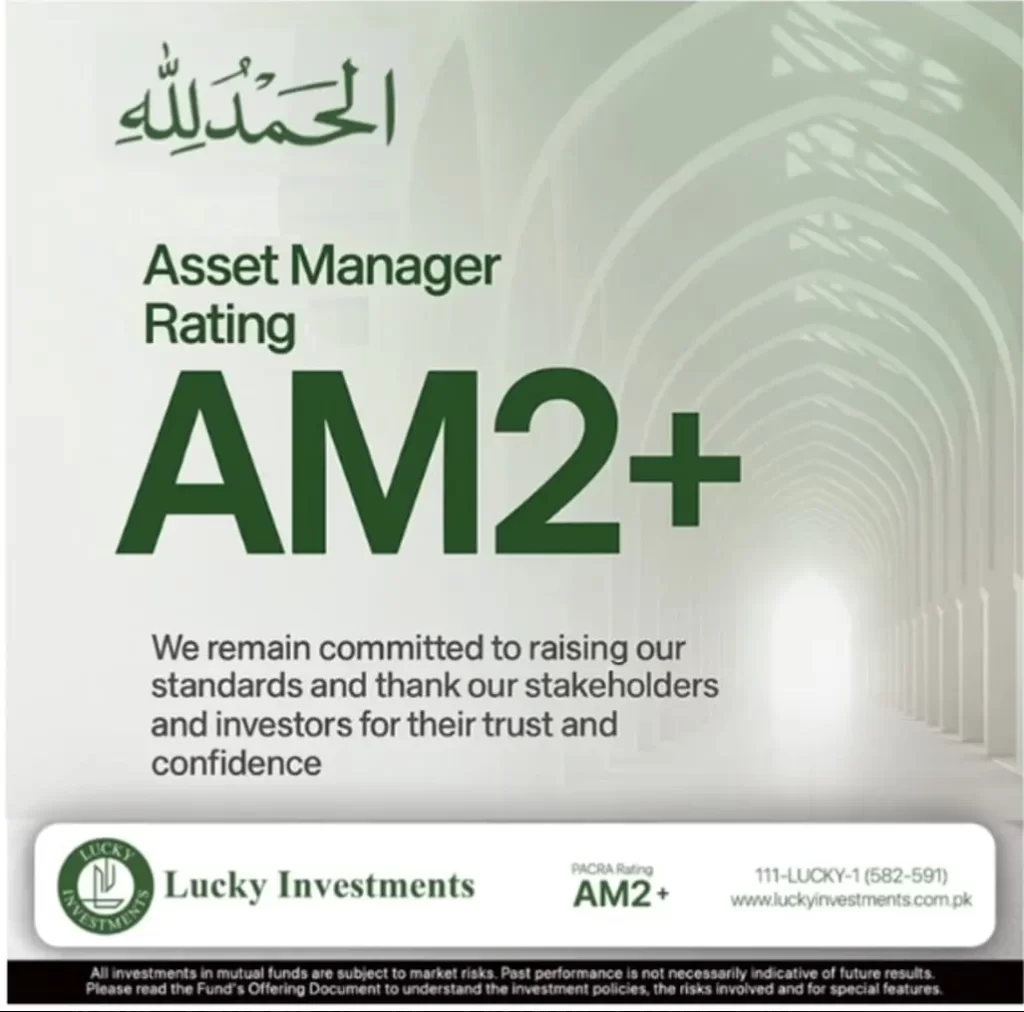
  • Lucky Investments Asset Manager Rating Upgraded to *AM2+ by PACRA

    Lucky Investments Limited (“Lucky Investments”) has been awarded an upgraded Asset Manager Rating of AM2+ with a Stable Outlook by the Pakistan Credit Rating Agency Limited (PACRA).

    This achievement reflects the Company’s exceptional growth in the Islamic asset management sector, securing over 4% market share within just a few months of operations.

    As a full-fledged Islamic asset management company, Lucky Investments is committed to becoming the premier choice for Shariah-compliant investment solutions in Pakistan. Its vision is anchored in sustainable growth, financial inclusion, integrity, and innovation.

    Commenting on the development, Mohammad Shoaib, CFA, CEO of Lucky Investments, said:

    “We are grateful to Allah (SWT) and to our valued investors for making this milestone possible. The upgraded rating is a testament to our strong sponsor backing, robust governance framework, and professional management team.

    We are determined to set new industry benchmarks and will continue to uphold the trust our stakeholders have placed in us.”

    PACRA’s upgraded rating highlights Lucky Investments’ solid capital base, sound governance, and strategic sponsor involvement, with active participation on the Board and key committees. It also recognizes the Company’s experienced leadership team and proven market track record.

    The Stable Outlook reflects the Company’s forward-looking initiatives and its growth potential as these strategies mature. Lucky Investments remains focused on strengthening its institutional framework, creating long-term value, and adhering to global best practices in Islamic finance.

    Since the launch of its first fund in April 2025, Lucky Investments’ Assets Under Management (AUM) have crossed PKR 80 billion. With its newly acquired Voluntary Pension Scheme (VPS) license, the Company is set to launch its VPS offerings soon, further encouraging retail investor participation in line with its long-term strategy. In addition, Lucky Investments is actively collaborating with provincial and federal governments to establish dedicated pension funds for government employees

    Also Read: Visa Cardholders Get First Shot at Applying for FIFA World Cup 26™ Tickets

  • Visa Cardholders Get First Shot at Applying for FIFA World Cup 26™ Tickets

    • Visa cardholders will score exclusive first access for a chance to purchase tickets to the world’s biggest tournament

    It’s official: the road to the FIFA World Cup 26™ starts with Visa. As the Official Payment Technology Partner of FIFA and a global leader in digital payments, Visa cardholders with a Visa Debit, Credit or reloadable Visa prepaid cards globally will receive exclusive early access to apply for tickets to the most anticipated sporting event in the world. The first-ever Visa Presale Draw was announced at the Visa Payments Vault in Washington, D.C., where government officials from Canada, Mexico and the United States gathered to celebrate trilateral collaboration and the unifying power of sport at the Visa FIFA World Cup 26™ Reception.

    “The FIFA World Cup 26™ is a moment of pride and possibility for our region. From Pakistan, where the official match ball is being crafted with world-class precision, to Jordan, celebrating its historic first qualification, the North Africa, Levant & Pakistan region is deeply woven into the fabric of this tournament. At Visa, we’re not just connecting fans to football — we’re empowering communities, entrepreneurs, and small businesses to thrive on the global stage. This is our time to shine,” commented Leila Serhan, Senior Vice President and Group Country Manager for North Africa, Levant and Pakistan at Visa.

    Empowering Fans

    From September 10-19, fans with a Visa card, including Visa Credit, Visa Debit and reloadable Visa prepaid cards, can apply to enter the Visa Presale Draw – a randomized selection process that gives selected entrants the chance to purchase tickets before general ticket sales open. Interested cardholders will need a FIFA ID to participate in the Visa Presale Draw and are encouraged to visit FIFA.com/tickets today to create their ID, if they don’t already have one. Those chosen to purchase tickets through the Visa Presale Draw will be notified by email starting no earlier than September 30 and given a dedicated time slot in October to purchase available tickets on a first come, first served basis. As the official payment method for FIFA ticketing, Visa will be the exclusive payment method accepted during the presale purchase window.  Learn more about the Visa Presale Draw here.

    “Excitement for the FIFA World Cup 26 is building fast, and 10 September is a date every football fan should have marked in their calendar,” said FIFA Chief Business Officer Romy Gai. “We’re delighted to once again partner with Visa to give fans the very first opportunity to apply for a place at the greatest show on earth. A ticket to the FIFA World Cup™ isn’t just a ticket—it’s a gateway to the most inclusive and spectacular tournament in our history. Everyone will want to be part of this moment, so make sure you’ve created your FIFA ID and have your Visa card ready.”

    Uplifting Communities and Small Businesses

    As Visa cardholders from around the world apply to secure exclusive ticket access for the FIFA World Cup 2026TM, Visa also wants to help businesses get ready to make the most of the moment. By sharing trends and expertise, Visa will help empower local businesses, especially in host cities – from street vendors in Mexico City to boutiques in Kansas City, or a local bakery in Vancouver– so they can capitalize on World Cup tourism and turn tournament fanfare into lasting economic growth. More details on these programs will be shared as the match draw approaches.


    A Tournament Like No Other

    The FIFA World Cup 2026™ promises to be record-breaking: 48 teams, 104 matches over 39 days in 16 iconic host cities and will be the first ever tri-country hosted games across North America. With nearly 20 years of partnership with FIFA, Visa and FIFA continue to innovate and expand access for fans, business owners and communities alike.

    Also Read: OICCI urges urgent climate financing to secure Pakistan’s future at the launch of its 3rd PCC Report

  • OICCI urges urgent climate financing to secure Pakistan’s future at the launch of its 3rd PCC Report

    Ranked first on the Climate Risk Index 2025 despite contributing less than 0.9 percent to global greenhouse gas emissions, Pakistan is bearing disproportionate losses. In 2022 alone, climate-induced disasters inflicted over USD 30 billion in damages, with recovery needs exceeding USD 16.3 billion. Air pollution alone causes over 128,000 premature deaths annually, while productivity in agriculture has declined by 10–20 percent due to climate variability, further straining livelihoods and the economy. Experts warn that Pakistan now requires USD 40–50 billion annually to effectively mitigate and adapt to climate risks.

    It is against this stark backdrop that the Overseas Investors Chamber of Commerce and Industry (OICCI) launched its 3rd Pakistan Climate Conference Report, titled “Creating an Enabling Environment for Private Sector Participation in Climate Resilience.” The report underscores the urgency of mobilizing climate finance at scale, with the private sector positioned as a central partner in building resilience.

    Speaking at the report launch, Secretary, Ministry of Climate Change and Environmental Coordination (MoCC&E) Aisha Humera Chaudhry said:
    “Pakistan’s climate vulnerability is a globally acknowledged reality. But to respond effectively, we must channel substantial and timely climate finance towards local solutions. The role of the private sector, as showcased by OICCI and its member companies, is central to our national climate strategy. We call on international partners to match Pakistan’s climate ambition with significant funding support.”

    The economic argument for climate finance is clear. Without urgent decarbonization, Pakistan’s exports face mounting risks under new global trade frameworks, such as the EU’s Carbon Border Adjustment Mechanism. Secretary General OICCI M. Abdul Aleem stressed: “Pakistan’s reliance on fossil fuels and carbon-intensive practices puts our exports at risk, especially under frameworks like the EU’s Carbon Border Adjustment Mechanism. Decarbonization and green finance are no longer optional, they are essential to sustaining economic growth and global competitiveness.”

    Executive Director SDPI Dr. Abid Suleri reinforced the need for collaborative policy and financing mechanisms: “In the context of eroding Public and grant based Climate Finance, market-based solutions and private sector is not part of problem but an amicable solution to climate crises. Climate catastrophes are not a future concern; it is today’s socioeconomic reality. Pakistan must now move beyond pledges and create an ecosystem where private investment in climate resilience is not only encouraged but enabled through consistent policy, data transparency, and accessible financing instruments.”

    President ACCA Ayla Majid emphasized the role of skills and financial expertise in climate action: “Mobilizing climate finance is not just about securing funds, it is about ensuring they are deployed effectively, with transparency and measurable impact. Building the financial, technical, and governance capacities to manage these resources is key to turning commitments into real resilience for Pakistan.”

    The 3rd PCC Report outlines actionable pathways in regenerative agriculture, industrial decarbonization, plastic circularity, and carbon market development. It emphasizes that climate funding must be paired with enabling policies and capacity-building to close Pakistan’s climate financing gap.

    OICCI, as the only private sector representative from Pakistan at COP28 and COP29, continues to champion public-private partnerships for climate action. The organization has engaged with regulators, including the State Bank of Pakistan and SECP, to advance green taxonomies and ESG reporting frameworks.

    Also Read: UBL partners with AUTON8 to deliver Landmark Automation Testing in Record Time

  • UBL partners with AUTON8 to deliver Landmark Automation Testing in Record Time

    United Bank Limited (UBL), one of Pakistan’s most established and progressive financial institutions, has successfully completed Phase 1 of its core banking automation testing program in just 16 weeks, delivered by automation partner AUTON8.

    This milestone marks a pivotal step in UBL’s digital transformation journey, validating its core systems with speed and accuracy to meet the demands of modern banking. Conducting end-to-end testing on decades-old core systems is among the industry’s most complex undertakings — one AUTON8 tackled with precision, agility, and AI-powered testing automation technology.

    Farasat Naqvi, EVP Core Banking at UBL, said:
    “AUTON8 brought unparalleled domain expertise, technical excellence, and a relentless problem-solving mindset. Completing this phase within such an ambitious timeframe reflects the strength of this partnership and positions UBL for greater agility and innovation.”

    For AUTON8, this achievement reinforces its role as a leading testing automation partner for complex banking environments, accelerating transformation with its AI-driven, no-code platform while ensuring quality assurance, compliance, and operational resilience.

    Ali Raza, COO of AUTON8, commented:
    “UBL’s bold vision to modernize and rigorously test such a historic core inspired us to deliver with speed and precision. This success reflects AUTON8’s mission — solving the industry’s most complex challenges with technology built for the future, but delivering today.”

    With this success, UBL lays a solid foundation for future transformation phases, with AUTON8 continuing as its trusted innovation partner for automated quality assurance and digital enablement.

    Also Read: Thar Projects Key to Energy Security and Regional Development: Minister Syed Nasir Shah

  • Ecommerce sector urges Govt for tax reduction and level playing field: PEA

    The Pakistan eCommerce Association (PEA) has urged the government to reduce the tax burden on the local e-commerce sector and digital payments to provide a level playing field for online sellers and domestic shopping platforms as compared with foreign marketplaces.

    The imposition of additional government taxes is negatively impacting the overall e-commerce ecosystem, including logistics companies, allied sectors, and overall business activities as a whole, said Omer Mubeen, Chairman – Pakistan eCommerce Association (PEA).

    “The tax disparity is not only limiting the growth of local businesses but is also forcing hundreds of small and medium enterprises (SMEs) and women entrepreneurs to shut down,” he added.

    The association has called on the government to provide tax relief to the e-commerce sector, pointing out that major local companies are already paying substantial amounts in income and sales taxes. “The increase in taxes will not only reduce the competitiveness of local players but will also hurt the sales of domestic e-commerce companies,” Mubeen said.

    In the 2025–26 federal budget, the government had levied new taxes on indigenous e-commerce companies at different rates, such as 18% GST and 0.25% to 2% cash-on-delivery and digital payment taxes.

    The government, in a similar vein, had levied a 5% flat rate tax on international online platforms like Temu, AliExpress, and SHEIN, but subsequently withdrawn it. On the other hand, taxes were maintained on indigenous e-commerce platforms.

    Shoaib Bhatti, President of the Pakistan eCommerce Association – Karachi Chapter, said the sector is demand taxation exemption but a flat rate of 0.25% on both cash-on-delivery and digital payments.

    “The removal of taxes on foreign e-commerce platforms will continue to cause an outflow of foreign exchange from the country, whereas domestic e-commerce companies generate business activity and create employment opportunities within the local economy,” he said.

    “At a time when Pakistan needs to expand its digital economy and create opportunities for its youth, these regressive tax policies will only push entrepreneurs out of business. We strongly urge the government to ensure a level playing field for all segments of the economy—both COD and digital—instead of discouraging online entrepreneurship,” he added.

    According to industry estimates, there are over 12,000 major e-commerce players and more than 200,000 small and medium-sized operators doing business in Pakistan, providing direct or indirect employment to over 500,000 people.

    Pakistan’s e-commerce industry has been growing at an average annual rate of 20–25% and is currently valued at approximately USD 7 billion (FY 2024), according to official market data. Nearly 70% of this ecosystem is driven by SMEs, which rely heavily on affordable digital tools and logistics to sustain operations.

    Also Read: Pakistan businesses’ confidence rises to a four-year high, Gallup Survey!

  • Pakistan businesses’ confidence rises to a four-year high, Gallup Survey!

    The confidence of Pakistan’s private businesses has surged in the country’s direction to its highest level in nearly four years, according to Gallup Pakistan’s latest survey. Also, an increasing number of businessmen have started thinking that Prime Minister Shehbaz Sharif’s government is managing Pakistan’s economy better than the previous government of his counterpart Imran Khan.

    The improvement comes despite inflation, high utility costs, and electricity load-shedding continue to hinder business operations.

    The Gallup’s business confidence survey for Q2 2025 was conducted between July 23 and 27 and captured the views of 524 businesses of Pakistan across manufacturing, services, and trade sectors. The standout finding from this quarter is a significant rebound in perceptions of the country’s overall direction. Gallup’s “Direction of the Country Score” now stands at -2 percent, a dramatic improvement from the far more pessimistic readings of late 2024.

    While the score remains marginally negative, it marks the highest level of confidence in national direction since Q4 2021. “This uptick suggests a moderate easing of political and economic uncertainty from the perspective of the business community,” the survey said.

    The number of businesses holding a good perception about Sharif government’s ability to manage the country’s economy has significantly improved over the past year. According to Gallup, 46 percent of businessmen rated the ruling Pakistan Muslim League-Nawaz government’s management of the economy as better than its predecessor, the Pakistan Tehreek-e-Insaf, compared to just 24 percent a year ago.

    Commenting on the survey, Gallup Pakistan Executive Director Bilal Ijaz Gilani said the survey’s latest edition was pointing to a “cautiously improving mood” among Pakistani businesses.

    “While the shift is incremental, it reflects a growing sense of stabilization among economic actors,” he said.

    The most visible change, Gilani said, was improvement in perception around the direction of the country and also positive trend in trust in the government’s handling of the economy.

    “As always, sustained momentum will depend on continued macroeconomic reforms, policy consistency, and greater institutional responsiveness, especially toward businesses operating outside the formal sector,” said the official.

    The business performance was another area that showed encouraging signs as 61 percent of respondents described their current operations as “good” or “very good,” up six percentage points from the previous wave.

    According to the survey, while the services and trade enterprises reported the largest gains, the respondents from manufacturing sector underscored comparatively slower signs of recovery.

    The survey found 61 percent of businesses optimistic about the coming months, with the Future Business Confidence score improving by just one percentage point.

    “This indicates that while businesses are not anticipating worsening conditions, there is also limited momentum for stronger optimism at this stage,” the survey said.

    Asked about challenges, the businessmen cited price hike and high energy costs and taxes as their biggest concern, which shows the structural challenges remain deeply entrenched in Pakistan’s business sector.

    Consumer price inflation, which has eased to a record 0.3 percent in April from 38 percent in May 2023, emerged as the most pressing issue, cited by 28 percent of respondents as the top priority for government action. High utility costs, 18 percent, while concerns over taxation, 11 percent, a slight decrease from last year’s levels.

    Energy insecurity also continues to affect operations as nearly half, 47 percent, of those surveyed said they were experiencing load-shedding on the day of the interview.

    “While still a concern, this figure is lower than during the same quarter in prior years, indicating some potential seasonal or regional relief,” according to the survey.

    One of the more notable shifts in 2Q survey is a substantial decline in reported bribery. Only 15 percent of respondents said they had paid a bribe in the past six months, down from 34 percent in Q4 2024. The prevalence of bribery was highest among traders (20 percent), followed by service providers (13 percent) and manufacturers (12 percent).

    Still concerning, the Gallup survey said, this decline may point to improving transparency or risk aversion among firms.

    Overall, the survey indicates a measured improvement in private sector sentiment, especially regarding the businessmen’s perceptions of national direction and current business operations.

    However, the survey found that forward-looking confidence of the businessmen has plateaued, and longstanding challenges like inflation, energy reliability and governance remain central to Pakistan’s business climate.

    Gallup’s Business Confidence Index is an important barometer capturing the sentiments of business community in any country and used across the world by policy makers.

    Also Read: PTCL Expands Strategic Partnership with Teradata to Strengthen Data & Analytics Capabilities

  • PAKISTAN MARITIME EXPO & CONFERENCE – PIMEC 2025

    The premier Edition of PIMEC-2025 is scheduled from 03-06 November 2025 at Karachi Expo Centre to showcase latest technology trends in maritime sector and provide opportunity for entrepreneurs, R&D specialists, financial experts and policy makers to promote cooperation in establishing business partnerships and joint ventures in the maritime domain under the patron of Ministry of Maritime Affairs along with Pakistan Navy.

    Second Steering Committee Meeting of Pakistan International Maritime Expo & Conference (PIMEC) was held on 06th August 2025 at Chief Minster House Karachi and was chaired by Mr. Syed Murad Ali Shah, Chief Minister Sindh. Representatives of Federal Ministries, various departments of Government of Sindh, Pakistan Army, Law Enforcement Agencies (LEAs) and Badar Expo Solutions, the Co-organizer of PIMEC attended the meeting. The Steering Committee Meeting was aimed to coordinate event related aspects with concerned stakeholders in bringing them at one page for holding this mega event of Pakistan at par with international standards.

    In his address, Chief Minister Sindh highlighted that PIMEC is aimed to promote Maritime potential and facilitate in capitalizing the benefits of the Blue Economy. He stressed that successful conduct of PIMEC is dependent on the support of government departments, business community and largely the people of Karachi. He hoped that with the support of all stakeholders, PIMEC-2025 will not only establish itself as flagship event for promotion of maritime sector thereby contributing towards economic wellbeing of the citizens of Pakistan but will also play a pivoting role in promoting the soft image of Pakistan.

    During the meeting, all government organizations and departments pledged their full support for successful conduct of PIMEC 2025.

    Also Read: Jazz Tops PTA’s QoS Survey Across All Major Metrics

  • DWP Group launches ‘Tameer-e-Mustaqbil’ to empower the next generation of professionals

    DWP Group has officially launched its flagship paid internship program, Tameer-e-Mustaqbil. The program marks a significant step forward in DWP Group’s commitment to nurturing young talent and building a stronger employer brand within Pakistan’s corporate sector.

    Designed as a structured, three-month development journey, Tameer-e-Mustaqbil is tailored to offer high-potential graduates a robust platform for professional growth. The inaugural cohort comprises top-tier graduates selected from leading universities across the country.

    The program offers interns a comprehensive experience, including direct mentorship from industry leaders, cross-functional exposure, and participation in real-time projects that emphasize innovation and collaboration. Weekly learning labs and “Intern Diaries” will ensure continual reflection and knowledge-sharing throughout the program.

    Farooq Naseem, Chairman and CEO of DWP Group, said, “At DWP Group, we believe that the future is built by those we invest in today. Tameer-e-Mustaqbil is not just an internship; it’s our promise to equip young professionals with the tools, mindset, and mentorship they need to thrive in a rapidly evolving world. This program reflects our deep-rooted belief in talent development and sustainable leadership for tomorrow.”

    Through Tameer-e-Mustaqbil, DWP Group aims to create a long-term pipeline of capable, future-ready professionals who will go on to contribute meaningfully to the organization and the industry at large.

    Also Read: Lucky Cement Partners with NLC to Offer Vocational Training to Youth from Lakki Marwat