Author: Admin

  • Transforming Child Health: How Community Incentives Drive Breakthroughs in Pakistan

    A groundbreaking study published in The Lancet Global Health reveals how community-driven incentives can greatly improve child health outcomes in rural Pakistan. The Community Mobilization and Community Incentivization- (CoMIC) trial, conducted by researchers from Aga Khan University’s Institute for Global Health and Development (IGHD), offers a transformative model for addressing preventable illnesses such as childhood diarrhoea and pneumonia, which remain leading causes of death among children under five.

    The CoMIC trial is based on the recognition that behaviour change interventions should ensure active community engagement and adapt context-specific strategies to facilitate change (bottom-up approach for sustainable improvement). When tied to tangible short-term collective benefits that address complex child health issues, such an approach may prove particularly useful. The study examined the impact of two interventions: community mobilization alone and mobilization combined with collective, conditional, non-cash incentives. It involved 48 clusters spread over a rural area in Sindh province.

    The findings revealed significant improvements in child health indicators in incentivized communities. Compared to the control groups, they included an 80% higher breastfeeding rate, a 50% rise in the use of oral rehydration treatments, a 30% improvement in cleanliness habit and a 30% higher immunization rate. Dr. Jai K. Das, Assistant Director at IGHD and lead author of the study explained: “The study shows that when communities are actively engaged, empowered, and take charge to set their own priorities, it leads to extraordinary results. The ability to choose non-cash rewards, such as water pumps or sanitation facilities, fostered a sense of ownership and accountability, driving sustainable behavior changes.”

    In Pakistan, the poorest populations are disproportionately affected by the substantial discrepancies in access to necessary health services.  Less than one-third of rural households have access to adequate sanitation, while the nation’s immunization rates are still at 66%. The CoMIC trial’s innovative approach—Conditional Collective Community-Based Incentives (C3I)—not only improved health behaviours but also encouraged communities to co-invest in long-term solutions. The findings showed that communities are more likely to invest when they are empowered to decide on incentives. This was evident by the fact that contributions including labour, land and supplies resulted in a cost-sharing rate of 36% above the 25% target. Along with encouraging sustainability and ownership, these community-driven incentives also had a number of positive effects such as better health outcomes, increased community well-being and improved sanitation.

    Dr. Zulfiqar A. Bhutta, Founding Director of IGHD, emphasized the broader implications of the trial: “This trial demonstrates the potential of community-driven solutions in achieving scalable health improvements. It is a model that can be adapted in other low- and middle-income countries to address inequities and save lives.”

    The CoMIC trial emphasizes how crucial it is to use community ownership and engagement to promote sustainable health improvements. Policymakers and organizations can adopt the Conditional Collective Community-Based Incentives model to address pressing public health challenges, particularly in low-resource settings.

    Scaling this approach could address vaccine resistance, improve sanitation, and enhance child health outcomes across diverse contexts. The framework offers a practical and transparent mechanism for delivering community-level benefits while fostering accountability and long-term investment in health infrastructure. Dr. Jai K. Das highlighted the broader applicability of the model, stating, “For a country like Pakistan, this approach could also be tested for other health challenges, such as malnutrition and polio vaccine hesitancy. Additionally, this strategy ensures transparency in fund utilization at the micro level, making it a viable option for broader adoption.”

    The CoMIC trial findings mark a significant step forward in global health innovation by offering a scalable and sustainable strategy to reduce child morbidity and mortality. It is recommended that the CoMIC model be explored by policymakers, donors, and global health organizations as a means of addressing health inequities through community ownership and collective action. Stakeholders may improve child health outcomes over the long run and encourage long-term community investment and accountability by giving priority to interventions that have tangible, immediate impacts.

    Also Read: Greenwich University, MAP and XPR Sign MoU for Enhanced Learning Opportunities
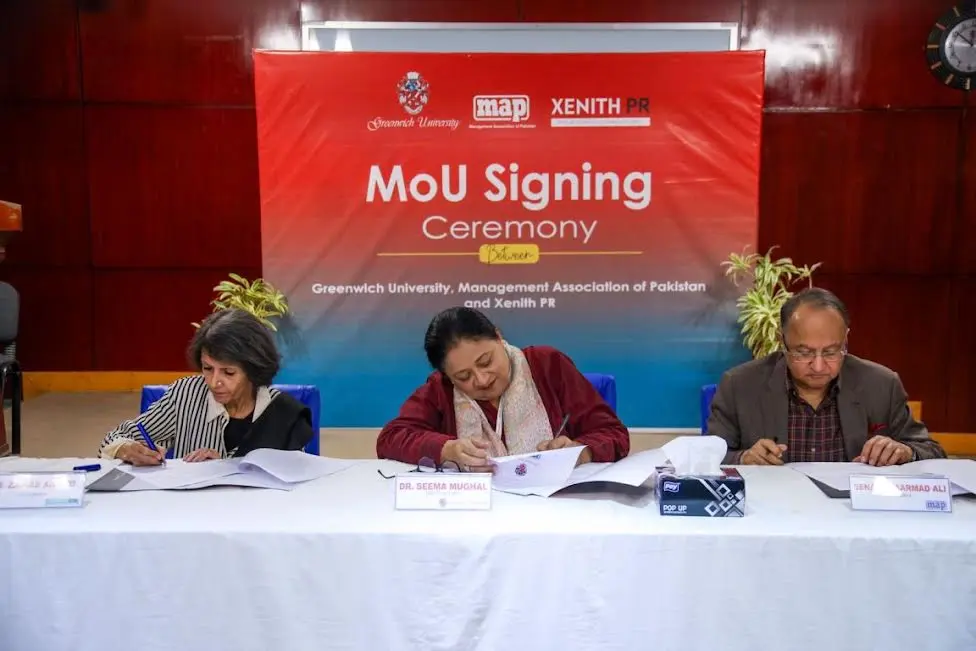
  • Greenwich University, MAP and XPR Sign MoU for Enhanced Learning Opportunities

    Greenwich University has signed a Memorandum of Understanding (MoU) with Management Association of Pakistan (MAP) and Xenith Public Relations (XPR) to co-create specialized diploma courses for students and young professionals in Pakistan. The unique tri-lateral collaboration, between a University, a Management Association and a Communications Firm, aims to equip students with in-demand skills, addressing industry gaps and strengthening ties between academia and the corporate sector.

    The MoU signing was officiated by Vice Chancellor of Greenwich University, Dr. Seema Mughal, President of Management Association of Pakistan, Senator Sarmad Ali and Chairperson of Xenith PR, Zainab Ansari.

    Speaking about the collaboration, Senator Sarmad Ali of Management Association of Pakistan (MAP), said: “We are happy to collaborate with Xenith PR and Greenwich University to launch specialized diploma courses for management professionals in Pakistan, which will help in capacity building and is aligned with our vision ‘To Lead the Change Process Towards Best Management Practices.’”

    Dr. Seema Mughal, Vice Chairman of Greenwich University, emphasized the university’s commitment to bridging the gap between theoretical knowledge and industry skills. “This collaboration with Management Association of Pakistan and Xenith PR marks a significant step in transforming education in Pakistan. Our shared vision is to equip students with specialized training that meets the real-world needs of organizations.”


    Zainab Ansari, Chairperson Xenith Public Relations, reflecting on the initiative said: ” I have spent many years in convincing major universities to incorporate public relations/communications department in their academics where, the industry leaders/specialists can share their practical knowledge and expertise with students interested in pursuing this career path. I am very happy that Greenwich, a progressive institute, has taken this initiative and we are very excited to partner with them in this endeavour.”

    The collaboration will focus on practical, industry-driven learning, ensuring students gain hands-on experience necessary to thrive in an evolving communications landscape. During the event, attendees toured the campus and discussed curriculum ideas tailored to meet real-world corporate demands.

    Raheel Nabi, CEO of Xenith PR, emphasized: “As pioneers in PR and communications talent development, we are committed to shaping the industry’s future. Empowering students with the right skills is crucial for building future leaders. This collaboration will produce job-ready professionals, benefiting not just our industry but the broader corporate sector in Pakistan. We are thankful to the leaders of Management Association of Pakistan and Greenwich University for becoming our partners in bringing, what would typically be, on-the-job skills to the classroom.”

    This initiative sets the stage for future industry-academia partnerships, fostering a workforce that is well-prepared to meet the challenges of an ever-evolving corporate landscape, from day one of their joining.

    Also Read: Empowering Education: BARD Foundation’s Enduring Legacy at LUMS

  • Cement domestic offtake – slight increase after many sluggish months

    According to the data released by All Pakistan Cement Manufacturers Association (APCMA), domestic cement despatches by the industry during the month of January 2025 were 3.313 million tons compared to 2.967 million tons in January 2024, showing an increase of 11.64%. Exports despatches also increased by 30.25% as the volumes increased from 446,595 tons in January 2024 to 581,691 tons in January 2025. Total cement despatches during January 2025 were 3.894 million tons against 3.414 Million Tons despatched during the same month of last fiscal year showing an overall increase by 14.08%.


    In January 2025, North based cement mills despatched 2.728 million tons cement showing an increase of 12.08% against 2.434 million tons despatches in January 2024. South based mills despatched 1.166 million tons cement during January 2025 that was 19.04% more compared to the despatches of 0.980 million tons during January 2024.


    North based cement mills despatched 2.669 million tons cement in domestic markets in January 2025 showing an increase of 11.89% against 2.385 million tons despatches in January 2024. South based mills despatched 644,173 tons cement in local markets during January 2025 that was 10.63% more compared to the despatches of 582,258 during January 2024.


    Exports from North based mills increased by 21.42% as the quantities increased from 48,883 tons in January 2024 to 59,355 tons in January 2025. Exports from South also jumped by 31.34% to 522,336 tons in January 2025 from 397,712 tons during the same month last year.


    During the first seven months of current fiscal year, total cement despatches (domestic and exports) were 26.827 million tons that is 1.71% lower than 27.295 million tons despatched during the corresponding period of last fiscal year. Domestic despatches during this period were 21.435 million tons against 23.196 million tons during same period last year showing a reduction of 7.59%. This downfall was subsided by export despatches that showed an increase by 31.54%. Export volumes jumped to 5.392 million tons during the first seven months of current fiscal year compared to 4.099 million tons exports done during same period of last fiscal year.


    North based Mills despatched 17.854 million tons cement domestically during the first seven months of current fiscal year showing a reduction of 6.80% than cement despatches of 19.157 million tons during July-January 2024. Exports from North however increased by 28.37% percent to 1.051 million tons during July-January 2025 compared with 819,353 tons exported during the same period last year. Total despatches by North based Mills reduced by 5.36% to 18.905 million tons during first seven months of current financial year from 19.976 million tons during same period of last financial year.


    Domestic despatches by South based Mills during July-January 2025 were 3.582 million tons showing reduction of 11.32% over 4.039 million tons cement despatched during the same period of last fiscal year. Exports from South increased by 32.33% to 4.340 million tons during July-January 2025 compared with 3.280 million tons exported during the same period last year. Total despatches by South based Mills increased by 8.24% to 7.922 million tons during first seven months of current financial year from 7.319 million tons during same period of last financial year.


    A spokesman of APCMA expressed continued concerns of the industry in relation to duties and taxes structure on cement that pose major bottleneck for domestic demand. “Cement being an essential commodity and not a luxury item, the Government should rationalize its tax structure, as the lower cost to end consumer will boost construction activities and employment in the sector,” he added.

    Also Read: Empowering Education: BARD Foundation’s Enduring Legacy at LUMS

  • Empowering Education: BARD Foundation’s Enduring Legacy at LUMS

    LUMS and the Bilquis and Abdul Razak Dawood (BARD) Foundation are proud to announce the naming of the Descon Auditorium, a 100-seat facility located in the upcoming Yusuf H. Shirazi Complex at LUMS. Made possible through the Foundation’s generous support, the auditorium will serve as a dynamic venue for lectures, discussions, and student activities, fostering intellectual exchange and collaboration.

    The BARD Foundation, established by Abdul Razak Dawood and Bilquis Dawood, has a longstanding association with LUMS, shaping its growth as a premier institution of higher learning. Since inception, the Dawood family has played a pivotal role in advancing education and supporting academic excellence at the University, that includes contributing to the establishment of the Suleman Dawood School of Business (SDSB), the creation of two endowed chairs and the naming of student housing facilities among other philanthropy initiatives. The Descon Auditorium represents the family’s continued investment in education, creating a space that inspires learning, dialogue, and innovation for generations to come.
    At the MoU signing ceremony, Abdul Razak Dawood said, “I want to thank our [Descon] executives—your efforts have made so much possible for LUMS. InshaAllah, we will continue to support LUMS for generations to come. As Syed Babar Ali always says, by giving, we never become poor. I also want to thank my family for their support in making this auditorium a reality—it will truly be a beautiful space.”
    The event was attended by the founders of the BARD Foundation, as well as members of its Board of Governors, including Faisal Dawood and Mehreen Dawood. Representing LUMS were Syed Babar Ali, Founding Pro Chancellor; Dr. Ali Cheema, Vice Chancellor; and Shahid Hussain, Rector, who acknowledged the Dawood family’s exceptional contributions to the university’s growth and impact.
    Expressing his gratitude for the Dawood family’s enduring support, Syed Babar Ali remarked, “I would like to thank everyone and express my deep appreciation for the generosity of Mr. Razak and his family. It is truly remarkable the amount of time he has dedicated to LUMS. I am pleased to see the next generation of the Dawood family here today. This institution will always need your contributions.”
    The naming of the Descon Auditorium highlights the power of strategic partnerships and the importance of philanthropy in the higher education space.
    Acknowledging the Dawood family’s continuous generosity, Dr. Ali Cheema noted, “Dawood family’s support has been fundamental to the development of education in our country. With the university’s expanding focus on academics, film, and theatre, our events and convocations can now carry even more significance. I would like to extend my gratitude to Descon, the Dawood family, and the BARD Foundation for their generous support and for making this naming possible.”
  • PTCL and MTronic set to redefine lifestyles by automating homes with cutting-edge IoT solutions

    Country’s leading telecom and ICT services provider, Pakistan Telecommunication Company Limited (PTCL), and smart home solutions provider, MTronic have entered into a strategic partnership to revolutionize living through cutting-edge Internet of Things (IoT) solutions. The collaboration aims to redefine lifestyles with a range of affordable, seamless, and user-friendly home technologies that deliver unprecedented convenience, home management, and a reduced carbon footprint.

    Amad Khan, Vice President of Products and Segments, PTCL, and Waqas Khalil, CBO of MTronic, signed the agreement in Islamabad in the presence of senior officials on both sides. The partnership aims to foster innovation and digital transformation in the country and encourage the adoption of IoT solutions for smart living.
    PTCL’s extensive customer base and robust digital infrastructure, combined with MTronic’s state-of-the-art IoT devices, ranging from smart sensors to automated lighting and thermostats, ensure nationwide access to cutting-edge living solutions. PTCL customers will enjoy exclusive discounts of up to 30%, making these lifestyle upgrades more accessible. Through PTCL’s user-friendly portal, customers can seamlessly explore and purchase these solutions, while MTronic handles end-to-end delivery, installation, and after-sales service. These smart devices powered by PTCL’s robust fiber internet will provide seamless, reliable and hassle-free experience for customers.
    Commenting on the development, Amad Khan, Vice President of Products and Segments, PTCL said, “PTCL is a key proponent of digital innovation and transformation in the country. By collaborating with MTronic, we are bringing the latest in smart home technology to our customers, making modern, connected living a reality. PTCL’s extensive network and commitment to innovation ensures that we are at the forefront of the IoT revolution in the country.”
    Waqas Khalil, CBO, remarked, “Our collaboration with PTCL is driven by a shared vision to enhance lifestyles through innovative smart home solutions. With PTCL’s market presence and our expertise in IoT technologies, we are confident in delivering exceptional value and convenience to our shared customers. Together, we aim to redefine what it means to live in a digitally connected home.”
    The forward-looking initiative offers unlimited possibilities in smart home management and digital living.  PTCL and MTronic will carry forward this collaboration to usher further ease and enablement to their shared customer base.

  • ABHI empowers PayPeople to enhance employee well-being

    ABHI, a leading embedded finance platform in the MENAP region, has partnered with PayPeople, a leading name in HR and payroll solutions, to transform the way employees manage their financial needs.


    This collaboration brings together extensive reach of PayPeople and expertise in financial services of ABHI to provide businesses with seamless access to financial wellness tools. Employees will benefit from real-time access to their earned wages through Earned Wage Access (EWA), reducing financial stress and enabling greater financial stability. This partnership aims to foster a more engaged, productive, and satisfied workforce.


    Rayaan Sayeed, Head of Sales of ABHI, said, ” As the Head of Sales at ABHI, I am excited about the value this collaboration will bring to businesses and their workforce. Together, we are simplifying access to financial wellness tools and enabling employees to manage their financial needs more effectively. By leveraging PayPeople’s extensive reach and ABHI’s expertise in financial services, this partnership is set to create a positive impact on employee productivity and satisfaction.


    For employers, this means streamlined payroll processes and the opportunity to support their teams in achieving financial resilience. At ABHI, we are committed to driving workplace innovation and empowering organizations to create lasting value for their employees, he said.


    This collaboration underscores ABHI’s commitment to delivering accessible and efficient financial solutions, empowering organizations to support their teams in achieving greater financial stability and peace of mind.

    Also Read: Visa Hosts Successful Inaugural Client – Focused Event in Pakistan

  • AI in Clinical Practice: Revolutionizing Healthcare at 26th NHSRS

    Experts from around the world gathered at the 26th National Health Sciences Research Symposium (NHSRS) at Aga Khan University (AKU) to discuss the rapidly evolving role of artificial intelligence (AI) in clinical practice. Over two days of keynotes, plenary talks, and pre-symposium workshops, leaders in medicine and technology explored how AI is revolutionizing healthcare delivery, education, and patient care.

    Dr. Adil Haider, Dean of AKU’s Medical College, opened the symposium by emphasizing the urgent need to adapt to the technological advancements reshaping healthcare. He noted that AI and machine learning have drastically changed how medical education is delivered, stating, “Rapid advances in AI and machine learning, along with global events like the Covid-19 pandemic, have shifted how we deliver and consume education. Moving to dynamic, student-centered learning is essential for staying relevant in this evolving landscape.”

    The integration of AI into healthcare has the potential to improve disease diagnosis, treatment selection, and clinical laboratory testing, consequently improving patient care, and quality of life. Professor Zara Cooper, Professor of Surgery at Harvard Medical School, shared her insights into AI’s potential to improve surgical care, noting that “AI can be harnessed to enhance palliative care, ensuring patients receive compassionate and precise treatment at every stage.”

    Professor Mayur Narayan, who leads the trauma department at AiACCESS, stressed the importance of addressing access disparities as AI technology advances in the surgical field. He stated, “AI has the power to revolutionize surgery, but it is crucial that we address the disparities in access and outcomes, ensuring that the benefits of innovation reach every patient.”

    Day two of the symposium featured plenary talks from experts such as Dr. Patricia Geli, co-founder and COO of C10 Labs, and Dr. Yasar Ayaz, a professor at NUST and Head of robotics and machine engineering. They explored the role of AI in streamlining healthcare operations, improving surgical techniques, and enhancing patient outcomes. One of the most anticipated sessions was “The Great Debate,” where participants discussed the ethical dilemmas of AI in healthcare and how to balance innovation with moral responsibility.

    Additional plenary talks were delivered by Mr. Shahid Azim, co-founder and CEO of Deep Tech Entrepreneur, who spoke on the intersection of technology and healthcare delivery, and Mr. Arhum Ishtiaq, cofounder of Connecthear, who discussed how AI can be used to develop hearing aids that significantly improve the quality of life for people with hearing impairments. His innovative work was recognized with the TRT World Citizen Award 2025.

    The 26th NHSRS reinforced the message that AI is not just a futuristic concept – it is the present. It’s transformative power must be understood and harnessed if we wish to progress, create impact and find meaningful solutions. The event highlighted the importance of ongoing dialogue, research, and education in ensuring that AI can be used effectively and responsibly to improve healthcare delivery and access across Pakistan and beyond.

    Also Read: DWP Technologies shines at DELL Partner Awards 2024 by winning best storage award

  • DWP Technologies shines at DELL Partner Awards 2024 by winning best storage award

    DWP Technologies Pvt. Ltd. Solutions Business Unit, Pakistan’s leading technology experts and part of the DWP Group, has been honored with the prestigious Best Storage Award at the DELL Partner Awards 2024, hosted by Dell Technologies Pvt. Ltd. This accolade celebrates DWP Technologies’ outstanding achievement in delivering the best project win for storage solutions.


    The award-winning project was executed for a leading integrated utility company in Pakistan that manages the generation, transmission, and distribution of energy. The initiative involved the consolidation and technology refresh of the client’s existing storage infrastructure. This complex undertaking required expertise in handling multiple operating systems, diverse applications, and a dynamic virtualization environment.

    DWP Technologies’ Solutions Business Unit rose to the challenge, demonstrating exceptional proficiency in deploying a sophisticated and reliable storage system for managing critical data. This achievement underscores the company’s commitment to delivering cutting-edge technology solutions and reinforcing its reputation as a leader in the technology sector.

    While expressing his gratitude, Rohail Bashir, Chief Operating Officer, DWP Technologies, said,
    “This award is a testament to our dedication to excellence and innovation. We are deeply honored to receive the Best Storage Award from Dell Technologies and extend our sincere thanks to our valued client for trusting us with this transformative project. This milestone inspires us to continue delivering impactful solutions that address the evolving needs of our partners and clients.”

    As DWP Technologies celebrates this remarkable milestone, the company remains steadfast in its mission to transform the technological landscape by delivering reliable, innovative, and future-proof solutions. With a focus on excellence, DWP Technologies is committed to driving meaningful advancements across industries and empowering organizations to achieve sustainable growth.
  • Visa Hosts Successful Inaugural Client – Focused Event in Pakistan

    Visa (NYSE: V), a world leader in digital payments hosted its inaugural market focused client event – Visa Connect Karachi – last week. Attended by more than 200 participants including senior members of the State Bank of Pakistan and the Pakistani financial industry, it marked the first event of its kind for Visa in the North Africa, Levant and Pakistan (NALP) region.

    Several regional experts presented insightful sessions on trends related to digital payments, unlocking business growth opportunities, new product solutions and AI-enabled digital experiences. A high-level panel with senior officials from government and banking also spoke to the needs of effective public and private sector partnerships.

    Umar Khan, Country Manager, for Visa in Pakistan and Afghanistan remarked, “Pakistan is accelerating its digitization journey and Visa Connect is a testament to our commitment to driving innovation and supporting our clients in navigating the evolving digital landscape. The event provided a platform for networking and knowledge sharing among industry leaders and clients, enabling us to have conversations that brought Visa’s global and regional insights to find solutions for local needs. We are energized by the conversations that took place at Visa Connect Karachi and the progress that we will bring as an industry as we continue to shape the future of commerce in Pakistan.”

    Mr. Saleem Ullah, Deputy Governor (Finance, Inclusion & Innovation) of the State Bank of Pakistan, emphasized the significance of the event, stating, “Visa Connect Karachi was a tremendous opportunity to interact with the senior leaders of Pakistan’s financial industry. It provided a platform to discuss the critical advancements and challenges within our sector. By focusing on mutually beneficial partnerships, we can significantly impact the financial landscape of Pakistan. Such collaborations are essential for fostering innovation and helps pave the way for a more robust and inclusive financial ecosystem that benefits everyone involved.”

    Also Read: 4th AlBaraka Forum Regional Conference Highlights Sukuk’s Role in Global Sustainable Finance

  • Local Tyre Manufacturers not Consulted for ITP Valuation

    Local tyre industry expressed its deep concern for not being consulted on recently issued ITP valuation VR-1958 & VR-1959 dated 17-1-2025.


    “As a local tyre producer and one of the major stakeholders in the industry, we wish to highlight that in light of the recent ITP valuation, we were unfortunately not consulted.


    “This lack of consultation is concerning and undermines the contributions of local manufacturers,” stated Hussain Kuli Khan, Chief Executive Officer/MD of GTR, in a letter to Director General of Customs Valuation.


    He mentioned that local tyre industry has a capability to fulfill the country’s tyre demand as we produce 80% of the sizes that are in demand, meeting the Original Equipment Manufacturers (OEM) strict quality requirement and supplying tyres to the replacement market.


    “This contributes significantly to saving foreign exchange, creating employment, and increasing tax revenue for the government exchequer,” reasoned Hussain.


    He added that as local tyre manufacturer our input is also vital in setting up ITP values and your good office [Customs Valuation] used to invite GTR along with different stakeholders.


    “But unfortunately in the last two valuation meetings we

    were not contacted. We strongly urge you to take us in confidence and ensure that our feedback is also taken into account during such meetings,” said Hussain.


    He requested the DG Customs Valuation to provide an opportunity for a meeting to discuss our point of view and take appropriate action to support the local tyre industry.


    It is pertinent to mention here that GTR is the largest local tyre manufacturer in Pakistan, producing tyres of international quality standards since its establishment in 1964.


    The GTR’s product range includes automotive tyres such as passenger car/SUV radials, light truck radial, truck bus, tractor, motorcycle and Off-the-Road (OTR) applications.

    Also Read: Auto sector raises alarm over NEV policy